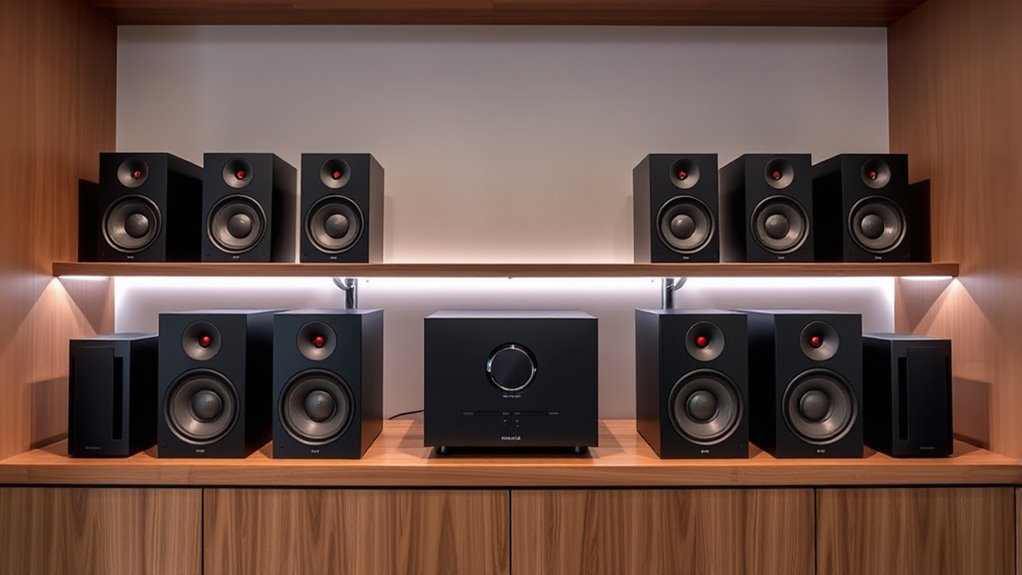

For audiophile listening without a separate amplifier, the Edifier S3000MKII is my best overall pick in this lineup for buyers seeking a more ambitious, high-output active system. The Edifier S2000MKIII stands out as a strong all-round alternative, while the Audioengine A5+ suits listeners who prefer a simpler wired setup. The main tradeoffs are sound refinement versus room-filling output, connection options versus ease of use, and speaker size versus placement flexibility. Smaller or more affordable models can make desktop listening straightforward, but they may offer less headroom or flexibility than larger systems. Read on for how each option fits a different listener and what to weigh before choosing.

Turn the school run and nap time into listening time
- Thousands of audiobooks, podcasts and originals
- Listen on your phone, tablet or Echo — also offline
- Cancel anytime
Complete the kit


Key Takeaways
- The S3000MKII models lead the premium end of this group, making the most sense when a buyer wants a powerful active system rather than the smallest desktop pair.
- The S2000MKIII and S1000MKII offer different routes to a feature-rich Edifier setup; compare their connections and intended room use instead of treating their model names as a simple quality ladder.
- Audioengine A5+ favors a straightforward wired system, while the Klipsch R-51PM and R-40PM bring a different mix of Bluetooth convenience and brand-specific speaker presentation.
- Edifier R1280T is the simpler entry point, but its more limited feature set makes it a better fit for basic near-field listening than for a system built around extensive source switching.
- Room size and placement can matter as much as speaker output: the larger R2750DB MKII and S3000MKII are less natural choices for cramped desks, while compact use cases favor smaller pairs.
| Edifier S2000MKIII Tri-Amped Bookshelf Speakers, 130W Studio Monitor |  | Best for Flexible, High-Output Listening | Power output: 130 watts | Woofer diameter: 5.5 inches | Tweeter diameter: 1 inch | VIEW ON AMAZON | See Our Full Breakdown |
| Audioengine A5+ Wired Bookshelf Speakers – Powered Speakers |  | Best for Wired Hi-Fi Setups | Power output: 150 watts | Woofer diameter: 5 inches | Tweeter diameter: 1.91 centimeters | VIEW ON AMAZON | See Our Full Breakdown |
| Klipsch R-51PM Powered Bluetooth Speaker, Black |  | Best for Turntable and TV Versatility | Amplification: Built-in amplifier | Speaker size: 5.25 inches | Tweeter diameter: 1 inch | VIEW ON AMAZON | See Our Full Breakdown |
| Audio-Technica AT-SP3XWH Powered Bookshelf Speakers (White) | 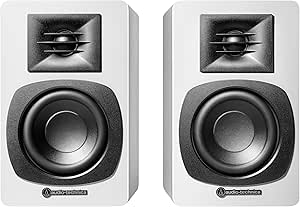 | Best Compact Pick | Woofer size: 3 inches | Tweeter size: 1.1 inches | Connectivity: Bluetooth, dual RCA | VIEW ON AMAZON | See Our Full Breakdown |
| Edifier S1000MKII Audiophile Active Bookshelf Speakers – 120W Bluetooth 5.0 with aptX HD, Optical Input, Near-Field Monitor with Class D Amp |  | Best for Near-Field Digital Listening | Power output: 120 watts | Amplifier: Class D, built-in | Frequency response: 45 Hz to 40 kHz | VIEW ON AMAZON | See Our Full Breakdown |
| Klipsch Reference R-40PM Powered Bookshelf Speakers |  | Best for Lively, Direct Listening | Speaker type: Powered bookshelf | Tweeter: 1-inch tweeter with 90° x 90° Tractrix horn | Woofer: 4-inch copper-spun TCP | VIEW ON AMAZON | See Our Full Breakdown |
| Edifier R2750DB MKII 3-Way Powered Bookshelf Speakers, 144W RMS, Walnut |  | Best for TV and Multi-Source Listening | Power: 144W RMS | Speaker system: Three-way | Woofer: 7 inches | VIEW ON AMAZON | See Our Full Breakdown |
| Edifier S3000MKII Audiophile Active Speakers | 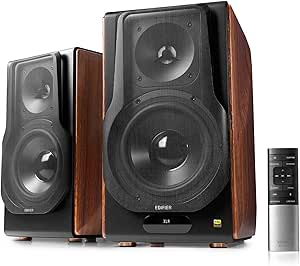 | Best for Planar-Tweeter Detail | Bluetooth: 5.0 with aptX | Driver type: Planar magnetic | Woofer: 6.5 inches | VIEW ON AMAZON | See Our Full Breakdown |
| Edifier S3000MKII Hi-Res 2.0 Audiophile Speakers, 256W RMS, Home Audio |  | Best for High-Output Connectivity | Power output: 256W RMS | Frequency response: 38 Hz–40 kHz | Speaker type: Bookshelf | VIEW ON AMAZON | See Our Full Breakdown |
| Edifier R1280T Powered Bookshelf Speakers – 2.0 Near Field Studio Monitor |  | Best for Straightforward Near-Field Listening | Power output: 42 watts RMS | Speaker type: 2.0 powered bookshelf | Woofer: 4 inches | VIEW ON AMAZON | See Our Full Breakdown |
| powered bookshelf speakers audiophile | Connectivity | Dimensions | Weight | Power output |
|---|---|---|---|---|
| Edifier S2000MKIII Tri-Amped B | — | 7.8 x 10.87 x 9.53 inches (D x W x H) | 17.14 kg | 130 watts |
| Audioengine A5+ Wired Bookshel | — | 9 x 10.75 x 7 inches (D x W x H) | 25 pounds | 150 watts |
| Klipsch R-51PM Powered Bluetoo | Bluetooth, USB, analog RCA, optical, phono preamp | — | — | — |
| Audio-Technica AT-SP3XWH Power | Bluetooth, dual RCA | 5.4 x 4.9 x 7.9 inches (D x W x H) | 1.45 kg | — |
| Edifier S1000MKII Audiophile A | — | 14.5 x 20.5 x 16 inches (D x W x H) | 16.7 kg | 120 watts |
| Klipsch Reference R-40PM Power | Bluetooth; turntable compatibility | 10.1 x 5.7 x 11.8 inches | 8.3 kg | — |
| Edifier R2750DB MKII 3-Way Pow | HDMI eARC, optical, coaxial, line-in, Bluetooth 6.0 | — | — | — |
| Edifier S3000MKII Audiophile A | Bluetooth, optical, coaxial, auxiliary, balanced inputs | 15.39 x 10.23 x 13.18 inches | 44.1 pounds | — |
| Edifier S3000MKII Hi-Res 2.0 A | Bluetooth, coaxial, optical, RCA, XLR | — | — | 256W RMS |
| Edifier R1280T Powered Bookshe | Auxiliary, RCA, PC audio | — | — | 42 watts RMS |
More Details on Our Top Picks
Edifier S2000MKIII Tri-Amped Bookshelf Speakers, 130W Studio Monitor
I’d put the Edifier S2000MKIII near the top for listeners who want substantial output and several ways to connect a system. Its tri-amped 130W design, 5.5-inch woofers, and planar diaphragm tweeters give it a more ambitious setup than the compact Audio-Technica AT-SP3XWH, while optical, coaxial, RCA, and Bluetooth inputs make it easier to use across a TV, computer, and wireless source. aptX HD Bluetooth and a remote add convenience without making wireless playback the only option. The tradeoff is physical: at 17.14 kg, these are heavy speakers that suit a settled indoor setup better than frequent rearranging. I’d choose them over the wired Audioengine A5+ when input flexibility matters more than a simple analog signal path, but skip them if desk space or portability is limited.
Pros:- Tri-amped 130W output and 5.5-inch woofers suit fuller, higher-level playback.
- Planar diaphragm tweeters are a distinctive high-frequency design feature.
- Optical, coaxial, line-in, dual RCA, and Bluetooth support varied sources.
- Wireless remote makes source and playback control easier from a listening seat.
Cons:- At 17.14 kg, the pair is cumbersome to reposition.
- Indoor-only use; the speakers are not water-resistant.
- Their size and weight call for sturdy, planned placement.
Best for: Listeners building a versatile living-room or desktop system who want high output, digital inputs, and Bluetooth in one powered pair.
Not ideal for: Buyers who need lightweight speakers for frequent moves, outdoor listening, or a very small desk.
- Power output:130 watts
- Woofer diameter:5.5 inches
- Tweeter diameter:1 inch
- Bluetooth:Version 5.0 with aptX HD decoding
- Inputs:Line-in, optical, coaxial, dual RCA
- Dimensions:7.8 x 10.87 x 9.53 inches (D x W x H)
- Weight:17.14 kg
- Enclosure:Wood
Our verdict“Choose the S2000MKIII if you want powerful, connected bookshelf speakers for a permanent indoor setup and can accommodate their weight.”
Audioengine A5+ Wired Bookshelf Speakers – Powered Speakers
The Audioengine A5+ is the straightforward choice here for buyers who prefer a wired stereo setup and do not need Bluetooth. Its stated 150W output, wood cabinets, and RCA and 3.5mm inputs make it a practical match for a computer, preamp, or other analog source. Compared with the Edifier S2000MKIII, the A5+ gives up wireless playback and optical or coaxial connections, but its simpler input set may suit a system built around one or two wired devices. The supplied details describe rich bass and clear highs, though they do not list a frequency response or digital inputs for closer system matching. At 25 pounds and a relatively large footprint, it is less appealing for a crowded desk than the Audio-Technica AT-SP3XWH. I’d shortlist it for a fixed listening space, not a compact wireless setup.
Pros:- 150W stated output provides headroom for home, office, or studio listening.
- RCA and 3.5mm inputs support common wired sources.
- Wood cabinets offer a more traditional finish than the AT-SP3XWH’s plastic enclosure.
- Three-year warranty is longer than the two-year coverage listed for the Edifier S2000MKIII.
Cons:- No Bluetooth or wireless playback option.
- No optical or coaxial input is listed, limiting direct digital-source connections.
- At 25 pounds with a sizable cabinet, placement may be difficult in small rooms.
Best for: Listeners with a computer, preamp, or other analog source who want powered stereo speakers and have room for a substantial pair.
Not ideal for: Buyers who expect Bluetooth, optical or coaxial inputs, or speakers that fit easily on a cramped desk.
- Power output:150 watts
- Woofer diameter:5 inches
- Tweeter diameter:1.91 centimeters
- Inputs:RCA, 3.5mm AUX
- Dimensions:9 x 10.75 x 7 inches (D x W x H)
- Weight:25 pounds
- Enclosure:Wood
- Warranty:3 years
Our verdict“Pick the A5+ if your sources are wired and you want a substantial stereo pair, but choose the S2000MKIII for Bluetooth and digital inputs.”
Klipsch R-51PM Powered Bluetooth Speaker, Black
I’d favor the Klipsch R-51PM when one pair of powered speakers needs to handle several kinds of sources, especially a turntable and TV. Its built-in amplification avoids a separate receiver, while Bluetooth, USB, optical, analog RCA, and a phono preamp cover more connection types than the Audioengine A5+ or compact Audio-Technica AT-SP3XWH. That breadth can simplify a mixed entertainment setup and leave room for future source changes. The listed 5.25-inch speaker size also puts it in the same general class as the Edifier S2000MKIII’s 5.5-inch woofer, though the available product data does not provide a direct power comparison. The compromise is a two-channel, mains-powered system with no outdoor protection. I’d pick it for source flexibility rather than a spec-led claim of audiophile refinement.
Pros:- Phono preamp supports a turntable without requiring a separate phono stage.
- Bluetooth, USB, optical, and analog RCA accommodate varied sources.
- Built-in amplification removes the need for an external receiver.
- Compact powered-monitor format suits mixed home audio and gaming setups.
Cons:- Stereo-only playback does not provide multichannel surround sound.
- Requires a power outlet and is not water-resistant.
- The provided specifications do not state a power-output figure for comparison.
Best for: Vinyl listeners and TV owners who want one powered stereo pair with a phono input, digital connections, and Bluetooth.
Not ideal for: Buyers seeking outdoor speakers, surround sound, or a compact system that runs without a wall outlet.
- Amplification:Built-in amplifier
- Speaker size:5.25 inches
- Tweeter diameter:1 inch
- Connectivity:Bluetooth, USB, analog RCA, optical, phono preamp
- Frequency response:21 kHz (as listed in product data)
- Channels:2
- Water resistance:Not water-resistant
- Warranty:2 years
Our verdict“Choose the R-51PM if turntable and TV connectivity matter more than a fully wireless or multichannel system.”
Audio-Technica AT-SP3XWH Powered Bookshelf Speakers (White)
For a small desk or shelf, the Audio-Technica AT-SP3XWH is the space-conscious option in this group. Its compact 5.4 x 4.9 x 7.9-inch cabinets and built-in amplification avoid the receiver and footprint associated with larger options such as the Edifier S2000MKIII. Bluetooth multipoint pairing lets two devices stay connected, while dual RCA inputs provide a wired alternative for a turntable, computer, or TV. That makes setup easy, but the 3-inch woofer and lack of a stated power figure offer less evidence for buyers prioritizing scale and output than the larger Edifier or Klipsch R-51PM. The plastic enclosure also feels less furniture-like than the wood cabinets on the Audioengine A5+. I’d choose these for convenience and a tight footprint, not for a room-filling system.
Pros:- Compact cabinets fit shelves and desks where larger Edifier models may not.
- Bluetooth multipoint supports simultaneous pairing with two devices.
- Dual RCA inputs add wired connections alongside Bluetooth.
- No external amplifier or receiver is required.
Cons:- The 3-inch woofer is smaller than the 5.25- and 5.5-inch drivers listed for the Klipsch and Edifier options.
- Plastic enclosure may feel less substantial than the wood-cabinet Audioengine A5+.
- Requires corded power and is not battery-powered.
Best for: Desk listeners and apartment dwellers who want a small powered pair for a computer, TV, or turntable, plus easy Bluetooth switching.
Not ideal for: Listeners who prioritize large-scale bass, high output, premium wood cabinets, or battery-powered portability.
- Woofer size:3 inches
- Tweeter size:1.1 inches
- Connectivity:Bluetooth, dual RCA
- Bluetooth range:10 meters
- Dimensions:5.4 x 4.9 x 7.9 inches (D x W x H)
- Weight:1.45 kg
- Enclosure:Plastic
- Power source:Corded electric
Our verdict“Pick the AT-SP3XWH for a compact, simple desktop or shelf system, but choose a larger model if room-filling scale is the priority.”
Edifier S1000MKII Audiophile Active Bookshelf Speakers – 120W Bluetooth 5.0 with aptX HD, Optical Input, Near-Field Monitor with Class D Amp
The Edifier S1000MKII makes sense for a listener who wants an active speaker system with digital inputs and a stated 45 Hz to 40 kHz frequency response. Its 120W Class D amplifier, Bluetooth 5.0 with aptX HD, and optical and coaxial connections make it more adaptable to a computer or TV setup than the analog-only Audioengine A5+. Against the newer S2000MKIII, it has a slightly lower stated output and fewer listed connection details; the S2000MKIII also specifies line-in and dual RCA. The S1000MKII still covers core digital and wireless needs without requiring a separate amplifier. Its major drawback is the listed 14.5 x 20.5 x 16-inch size and 16.7 kg weight, which make compact near-field placement harder than the Audio-Technica AT-SP3XWH. I’d verify available space before choosing it.
Pros:- Built-in 120W Class D amplification keeps the system self-contained.
- Bluetooth 5.0 with aptX HD supports wireless listening.
- Optical, coaxial, and AUX inputs cover common wired sources.
- The listed 45 Hz to 40 kHz response gives buyers a stated range for system comparison.
Cons:- Listed dimensions are large for a near-field or small-desk setup.
- At 16.7 kg, the speakers are cumbersome to reposition.
- The S2000MKIII lists higher output and additional line-in and dual RCA connections.
Best for: Near-field listeners with a computer or TV who want Bluetooth and direct optical or coaxial connections in an active speaker system.
Not ideal for: Buyers with small desks, limited shelf space, or a need to move speakers frequently.
- Power output:120 watts
- Amplifier:Class D, built-in
- Frequency response:45 Hz to 40 kHz
- Bluetooth:Version 5.0 with aptX HD
- Inputs:Optical, coaxial, AUX
- Speaker size:5.5 inches
- Dimensions:14.5 x 20.5 x 16 inches (D x W x H)
- Weight:16.7 kg
Our verdict“Choose the S1000MKII if its digital inputs and stated response fit your desk or TV system, but compare the S2000MKIII if you want more listed input options.”
Klipsch Reference R-40PM Powered Bookshelf Speakers
The R-40PM suits listeners who want an immediate, forward presentation and turntable-friendly connectivity without adding a separate amplifier. Its 90° x 90° Tractrix horn guides high frequencies across the listening area, while the 4-inch copper-spun woofers keep the cabinets relatively compact. Compared with the larger Edifier R2750DB MKII, the Klipsch is easier to place but has less woofer area for weighty bass and room-filling low end. Bluetooth adds convenient playback, though the listed range is 10 meters, and corded power means these are not grab-and-go speakers. I’d choose them for a desktop or modest living room where crisp, direct sound matters more than deep bass. Skip them if your priority is strong low-frequency impact without a subwoofer.
Pros:- Tractrix horn helps project treble clearly toward the listening position
- Bluetooth and turntable compatibility support convenient wireless and vinyl setups
- Compact cabinet is easier to place than the Edifier R2750DB MKII
- Magnetic grilles give the speakers a clean, low-profile appearance
Cons:- 4-inch woofers are less suited to deep, forceful bass than larger alternatives
- Requires a power connection and some setup rather than operating as a portable speaker
Best for: Listeners seeking compact powered speakers for near-field music or turntable playback who prefer a lively, direct sound.
Not ideal for: Buyers filling a large room or wanting substantial deep bass from the speakers alone; the 4-inch woofers have physical limits.
- Speaker type:Powered bookshelf
- Tweeter:1-inch tweeter with 90° x 90° Tractrix horn
- Woofer:4-inch copper-spun TCP
- Connectivity:Bluetooth; turntable compatibility
- Bluetooth range:10 meters
- Dimensions:10.1 x 5.7 x 11.8 inches
- Weight:8.3 kg
- Power source:Corded electric
Our verdict“Choose the R-40PM for compact, horn-loaded clarity and flexible playback, but pick a larger speaker if bass weight is your main goal.”
Edifier R2750DB MKII 3-Way Powered Bookshelf Speakers, 144W RMS, Walnut
The R2750DB MKII earns its place through a broad mix of inputs and a three-way driver layout, making it a strong fit for buyers who want one speaker system to handle music and television. HDMI eARC, optical, coaxial, line-in, and Bluetooth 6.0 give it more connection flexibility than the simpler Edifier R1280T, while the 7-inch woofer and 4.5-inch midrange offer more physical scale than the Klipsch R-40PM’s 4-inch drivers. That extra capability comes with larger cabinets and more setup choices, which can be a poor match for a crowded desk. App sound profiles and a remote make adjustments accessible, but this is still a substantial two-speaker system rather than a discreet desktop pair. I’d shortlist it for a living room or media room with several sources.
Pros:- HDMI eARC, optical, coaxial, line-in, and Bluetooth accommodate varied sources
- Three-way design separates woofer, midrange, and treble duties
- 7-inch woofer provides more low-frequency potential than the Klipsch R-40PM
- App sound profiles and remote control provide convenient listening adjustments
Cons:- Bulky cabinets can crowd small desks and shallow shelves
- Many connection and setup options may be unnecessary for a single-source system
Best for: TV and music listeners who want HDMI eARC, several digital inputs, and fuller speaker scale in a living-room setup.
Not ideal for: Desktop users with limited shelf space or buyers who want a simple, compact speaker pair with minimal connections.
- Power:144W RMS
- Speaker system:Three-way
- Woofer:7 inches
- Midrange:4.5 inches
- Tweeter:1-inch silk dome
- Connectivity:HDMI eARC, optical, coaxial, line-in, Bluetooth 6.0
- Supported audio:Hi-Res Audio, 24-bit/96kHz DSP, LDAC
- Expandability:Subwoofer output
Our verdict“Pick the R2750DB MKII for a flexible TV-and-music setup with substantial drivers, provided you have room for its larger cabinets.”
Edifier S3000MKII Audiophile Active Speakers
The S3000MKII is the pick here for listeners drawn to a detailed high-frequency presentation and broad source compatibility. Its planar magnetic tweeters distinguish it from the silk-dome tweeter in the R2750DB MKII, while 6.5-inch woofers give it a larger foundation than the Klipsch R-40PM. Bluetooth 5.0 with aptX sits alongside optical, coaxial, auxiliary, and balanced inputs, so it can serve a computer, TV, or separate audio source. The tradeoff is physical: at 44.1 pounds and over 15 inches deep, this is not a casual desktop choice. The stated 38 Hz frequency response gives a low-end reference, but the supplied data does not specify a tolerance. I’d favor it over the smaller Edifier R1280T when detail and input variety matter more than space.
Pros:- Planar magnetic tweeters set it apart from conventional dome-tweeter options
- 6.5-inch woofers provide a larger driver platform than the Klipsch R-40PM
- Bluetooth aptX, optical, coaxial, auxiliary, and balanced inputs support varied sources
- Bass, treble, and volume controls allow sound adjustment
Cons:- 44.1-pound listed weight and deep cabinets demand sturdy, spacious placement
- No waterproofing is specified, so it is intended for indoor use
- Large format may be excessive for close desktop listening
Best for: Listeners building a dedicated home listening or computer setup who want planar-tweeter detail, multiple inputs, and room for substantial speakers.
Not ideal for: Small-desk users, frequent movers, or buyers seeking a light, compact pair that is easy to reposition.
- Bluetooth:5.0 with aptX
- Driver type:Planar magnetic
- Woofer:6.5 inches
- Tweeter:1 inch
- Frequency response:38 Hz
- Maximum output power:100 watts
- Connectivity:Bluetooth, optical, coaxial, auxiliary, balanced inputs
- Dimensions:15.39 x 10.23 x 13.18 inches
- Weight:44.1 pounds
Our verdict“Choose the S3000MKII for a substantial indoor system centered on planar-tweeter detail, not for a cramped desk or frequent relocation.”
Edifier S3000MKII Hi-Res 2.0 Audiophile Speakers, 256W RMS, Home Audio
This S3000MKII listing is the strongest match for buyers who want a high-output powered pair with both consumer and professional-style connections. It combines 256W RMS, planar magnetic tweeters, and 6.5-inch aluminum woofers with Bluetooth, RCA, optical, coaxial, and XLR inputs. That range is broader than the R-40PM’s Bluetooth-and-turntable-oriented setup and can suit a mixed home audio system. Compared with the other Edifier S3000MKII in this roundup, this listing specifies XLR and USB-related customization claims in its description but does not list dimensions or weight; the shared model name does not make the supplied specifications identical. Its multiple inputs and app controls may take more setup than the straightforward R1280T. I’d choose it when connection flexibility and stated output are priorities, not when simplicity or a small footprint comes first.
Pros:- 256W RMS output is the highest power figure listed among these five products
- XLR, RCA, optical, coaxial, and Bluetooth support varied audio sources
- Planar magnetic tweeters and 6.5-inch aluminum woofers form a high-resolution driver combination
- App and remote controls offer EQ presets and sound adjustment
Cons:- Multiple input choices and controls may complicate setup for beginners
- Large size may not suit compact rooms or desks
- The supplied specs omit dimensions and weight, making placement planning harder
Best for: Home listeners connecting several sources, including equipment with XLR outputs, who want high stated output and app-based sound adjustment.
Not ideal for: First-time buyers seeking simple plug-and-play controls or anyone short on shelf space; this is described as a large, multi-input system.
- Power output:256W RMS
- Frequency response:38 Hz–40 kHz
- Speaker type:Bookshelf
- Woofer:6.5-inch aluminum
- Driver type:Planar magnetic
- Connectivity:Bluetooth, coaxial, optical, RCA, XLR
- Mounting type:Tabletop
- Color:Brown
Our verdict“Choose this S3000MKII listing for its stated output and broad input selection, but favor the R1280T if you want a simpler, lower-complexity setup.”
Edifier R1280T Powered Bookshelf Speakers – 2.0 Near Field Studio Monitor
The R1280T is the uncomplicated choice for a desk or small listening setup: its 42W RMS output, dual AUX inputs, RCA connections, remote, and bass-and-treble controls cover everyday near-field use without the extensive feature set of the R2750DB MKII. Its 4-inch woofer is closer in scale to the Klipsch R-40PM than to the 6.5- and 7-inch drivers in the Edifier S3000MKII and R2750DB MKII, so I would not select it for strong bass in a large room. The classic wood finish also makes it easier to blend into home décor than the Klipsch’s modern black look. One spec lists dimensions unusually large for this class, so I’d verify the actual cabinet measurements before planning a tight shelf fit. It suits buyers who value simple wired playback and basic tone control.
Pros:- Dual AUX and RCA inputs accommodate common wired sources
- Remote control and bass/treble adjustment make everyday listening convenient
- Wood finish offers a classic appearance distinct from the Klipsch R-40PM
- Near-field design suits desktop and close listening
Cons:- 4-inch woofer and listed 80 Hz frequency response limit low-bass reach
- No Bluetooth or subwoofer support is listed
- Listed dimensions are unusually large for this speaker class and merit checking before purchase
Best for: Desk listeners and compact-room users who want a straightforward powered pair with RCA/AUX sources, a remote, and basic tone adjustment.
Not ideal for: Listeners seeking deep bass, high output for a large room, Bluetooth streaming, or a system with a subwoofer output.
- Power output:42 watts RMS
- Speaker type:2.0 powered bookshelf
- Woofer:4 inches
- Tweeter:13 mm
- Connectivity:Auxiliary, RCA, PC audio
- Frequency response:80 Hz
- Impedance:4 ohms
- Signal-to-noise ratio:85 dB
- Warranty:2 years
Our verdict“Choose the R1280T for simple wired near-field listening and tone controls, but look to a larger model for deeper bass or room-filling output.”

How We Picked
I ranked these speakers around the needs behind the phrase powered bookshelf speakers for audiophile listening: sound-system capability without a separate power amplifier, practical source connections, and a sensible match for the room and listening distance. I weighed each model’s stated output and design alongside its connectivity, likely setup demands, and role in a real home or desktop system. A large power figure alone did not earn a higher position; usable inputs, system flexibility, and the likelihood that the speaker fits the buyer’s space mattered too.
The order reflects versatility and overall system potential first, then more specific strengths such as wired simplicity, compact placement, or entry-level accessibility. The two S3000MKII listings are distinct entries in the requested lineup, but they name the same speaker model; I treat them as one underlying option rather than implying that the repeated listing represents a separate design. Each pick also carries a tradeoff: buyers should compare the room, sources, and listening habits they actually have, rather than choosing by headline specifications alone.
Factors to Consider When Choosing Powered Bookshelf Speakers Audiophile
Before picking a model, I would match the speaker to the system around it. A powered pair removes the need for a separate power amplifier, but it does not automatically solve questions about inputs, placement, listening distance, or future upgrades. These broader checks can prevent a speaker that looks appealing on paper from becoming awkward in everyday use.
Match Speaker Scale to Your Room
A speaker that fills a living room may feel excessive on a narrow desk, while a compact pair can run out of authority when asked to serve a larger space. Think about the distance from the speakers to your ears and whether you listen near-field or across the room. Also check cabinet dimensions against shelves, stands, and desk depth; rear-facing ports can need breathing room behind the cabinets. A common mistake is to use wattage as a stand-in for room suitability, even though placement and listening distance shape the result. Choose a larger design when you need more output and have room to position it, not just because its specification looks more impressive. For tight workspaces, physical fit and useful listening levels should outrank maximum output claims.
Choose Inputs Around Your Actual Sources
List every source you expect to connect, such as a computer, television, turntable with a suitable phono stage, streamer, or phone. Then confirm which inputs are available and whether switching between sources is simple enough for daily use. Bluetooth is handy for casual playback, but a wired digital or analog connection may better suit a fixed system or a source that lacks wireless support. Do not assume that a speaker’s wireless capability replaces every cable you need; Bluetooth codecs and device compatibility can affect the connection options available. If a television is central to the setup, verify the exact input and control arrangement before buying. Paying for extra connectivity is worthwhile only when it reduces friction in your own system.
Separate Amplifier Power From Sound Quality
Output ratings describe only part of a speaker’s capabilities and do not establish tonal balance, detail, or suitability for a room. A high-output model may offer more headroom for lively playback, yet a carefully matched smaller pair can be the more satisfying choice at a desk. Compare cabinet design, driver arrangement, and the available sound adjustments alongside stated power. Another frequent mistake is treating labels such as “studio monitor” or “audiophile” as a guarantee of a preferred sound; these terms do not replace listening priorities. Buyers who value natural vocals may make a different choice from those who want forceful playback or adjustable voicing. When possible, use a return-friendly seller or listen before committing, since personal preference cannot be settled by specifications alone.
Plan for Placement and Room Acoustics
Speaker placement can change the perceived bass and stereo image enough to outweigh a model-to-model specification difference. Keep left and right speakers at similar heights and distances from the listening position, and avoid trapping them tightly in corners unless the design and room suit that placement. Stands can help bring tweeters closer to ear level and reduce desk reflections, but they add cost and take up floor space. Hard walls, bare desks, and reflective surfaces may make some rooms sound lively or uneven, so soft furnishings and small placement changes can help. A common buying error is spending the full budget on the speakers while leaving no room for stable stands or sensible positioning. Consider the complete setup footprint before choosing a large cabinet.
Know What an Active System Can and Cannot Upgrade
Powered speakers simplify a system by housing amplification in the cabinets, but they also make future changes different from those in a passive setup. You can often change sources or add compatible components, yet you cannot swap in a separate power amplifier in the same straightforward way. Check whether the system has the inputs and controls you expect to keep using over time. If you value minimal components and direct setup, that tradeoff is often welcome; if you expect to build a modular stereo system, passive speakers may suit you better. Also consider what happens if one speaker’s electronics need service, since the amplification is part of the speaker system. Paying more makes sense when it buys features and performance you will use, not simply a larger specification sheet.
Frequently Asked Questions
Are the two Edifier S3000MKII listings different speakers?
Both entries name the Edifier S3000MKII, so the lineup does not establish them as separate speaker designs. I would treat them as duplicate listings for comparison purposes and verify the exact model, included accessories, and seller information before ordering. The repeated entry should not be read as evidence of two distinct performance tiers. If you are deciding between the S3000MKII and another model, compare it against the S2000MKIII or R2750DB MKII based on room fit, connections, and intended output. That provides a more useful distinction than comparing the duplicated names.
Can I connect a turntable directly to any of these powered speakers?
Not automatically: a turntable needs a phono preamp unless one is built into the turntable or supplied as a separate component. Before choosing a speaker, check whether it accepts the resulting line-level signal through a compatible analog input. Do not connect a turntable’s phono-level output to a line input and expect normal volume or correct tonal balance. If your turntable has no built-in preamp, include a standalone phono stage in the system plan. This connection check matters more than Bluetooth support when vinyl is your main source.
Should I choose Bluetooth or a wired connection for critical listening?
For a fixed listening system, a wired connection is often the simpler way to avoid wireless compatibility questions and keep the source path consistent. Bluetooth can still be convenient for casual playback, and the Edifier S1000MKII specifically lists aptX HD support, but the phone or computer must also support a compatible codec for that benefit to apply. Wireless playback does not make every file or source high resolution by itself. Consider how you listen most often: a desk computer or television may favor a direct cable, while shared phone playback can make Bluetooth useful. A speaker with both options gives flexibility, but only if its wired inputs suit your equipment.
Is a larger powered bookshelf speaker a better choice for a large room?
A larger design can offer more output capacity, but cabinet size alone does not guarantee even coverage or satisfying bass throughout a room. Listening distance, room layout, speaker placement, and the desired playback level all affect the result. The R2750DB MKII or S3000MKII may make more sense than the compact R1280T when the system needs greater scale, but placement still matters. If you need deep bass at higher levels, a compatible subwoofer may be a better addition than expecting bookshelf speakers to do everything. Measure your space and consider where the speakers can sit before moving up in size.
When should I choose passive speakers instead of powered bookshelf speakers?
Powered speakers suit buyers who want amplification built into the pair and fewer separate components. Passive speakers may be a better fit if you already own an amplifier, want to change amplifiers later, or prefer building a modular system piece by piece. The active options in this roundup simplify setup, but their built-in amplification ties the system more closely to each speaker model. Compare the total system you want, including source switching and room placement, rather than comparing speaker cabinets alone. If upgrade flexibility matters more than a compact, direct setup, passive speakers deserve a place on your shortlist.
Conclusion
For the strongest all-round choice among these active options, I would start with the Edifier S3000MKII, particularly for a listener with space for a larger, more ambitious system. The best value-oriented starting point is the Edifier R1280T for simple near-field use, while the best beginner pick is also the R1280T if straightforward setup matters more than broad features. For a more feature-rich middle ground, compare the S2000MKIII and S1000MKII against your source and room needs; the Audioengine A5+ is the wired-simplicity choice. Buyers seeking a larger Edifier alternative should look at the R2750DB MKII, while listeners drawn to Klipsch should compare the R-51PM and R-40PM on their connection needs and cabinet fit. The premium recommendation is the S3000MKII, but I would skip it for a crowded desk; choose the speaker whose scale, inputs, and setup match how you actually listen.
Halloween Picks
halloween
As an affiliate, we earn on qualifying purchases.