📊 Full opportunity report: Managing Parental Permissions Across Kid-Facing Products on IdeaNavigator AI — validation score, market gap, and execution plan.

Turn the school run and nap time into listening time
- Thousands of audiobooks, podcasts and originals
- Listen on your phone, tablet or Echo — also offline
- Cancel anytime
TL;DR
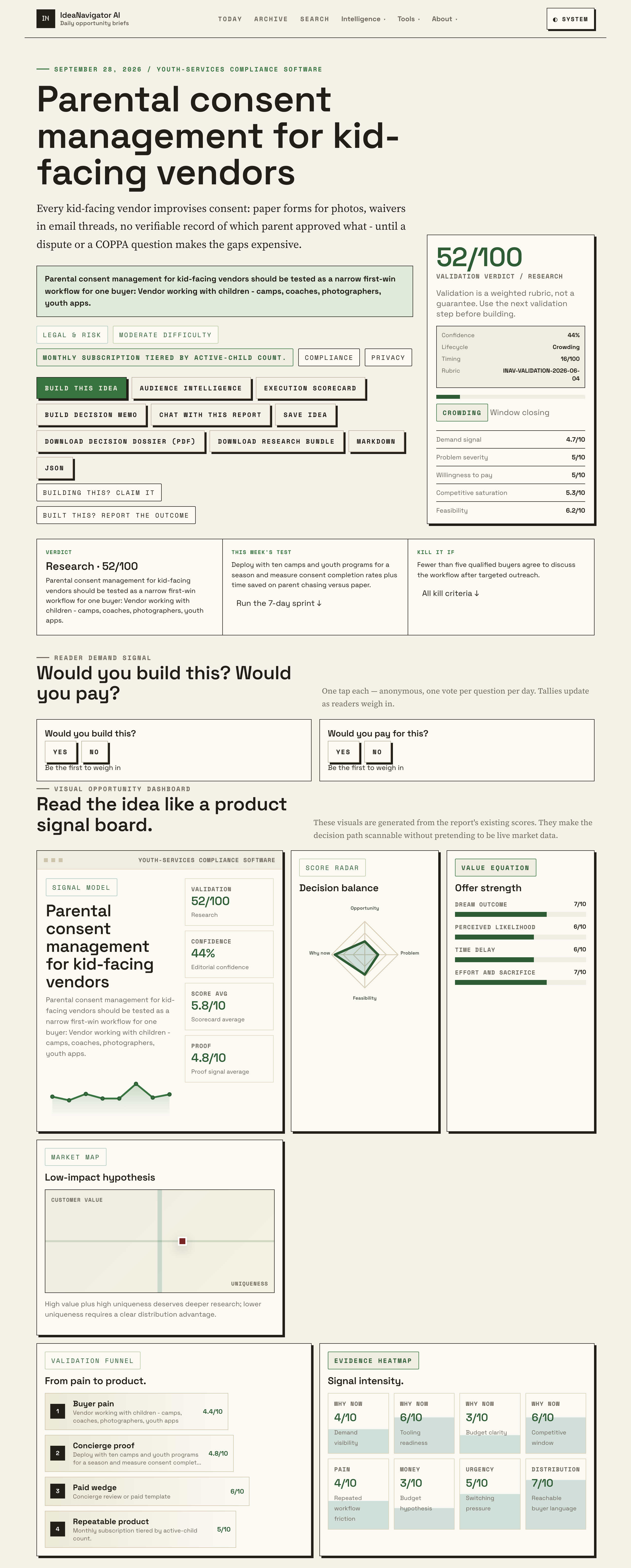
A proposal from IdeaNavigator AI describes software for youth-service vendors to collect and track parental permissions through phone-based forms. The proposal reports no product launch, participating vendors, or pilot results; it recommends a seasonal trial with ten programs.
IdeaNavigator AI has outlined a proposed consent management service for camps and other vendors working with children, aiming to replace scattered forms and email records with phone-based parental permissions and per-child records. The IdeaNavigator AI proposal describes an early product concept, not a confirmed launch or a completed pilot, so its effectiveness and demand have not yet been established.
According to the IdeaNavigator AI proposal, the service would let a vendor create branded forms for parents to complete on their phones. The listed permission types include photo use, data collection, medical information, and liability waivers. The concept also calls for identity checks matched to the risk level, records organized by child, tracking for consent expiry, and an exportable audit history.
The proposal identifies organizations that work directly with children as intended customers, including camps, coaches, photographers, and youth apps. It says these providers often manage consent through paper forms and email exchanges, which can leave them without a clear record of which parent approved which use. The proposal does not provide survey results or other evidence establishing how common that problem is.
The proposed business model is a monthly subscription priced by active-child count, according to the proposal. To test the idea, it recommends deploying the service with ten camps and youth programs for a season and measuring parent completion rates and staff time spent following up for consent compared with paper processes. The proposal identifies no participating organizations, trial dates, pricing figures, or results.
Records for Youth Programs
For an organization that works with children, a permission record may need to show who approved what, for which child, and when. The IdeaNavigator AI proposal says a shared digital record could make it easier for staff to check permissions before using a photo or collecting information. That benefit is proposed, however; no operational results are available to show whether the described product would reduce errors or disputes.
The proposal also points to a practical administrative burden. It says small programs may collect forms at enrollment, through email, or during the season, leaving staff to chase missing responses and reconcile different records. If a phone-based workflow is easier for families to complete and for staff to maintain, it could reduce that work. The proposed seasonal test is intended to measure completion and follow-up time, but the proposal specifies no target rate or comparison method.
The proposal cites changing children’s privacy requirements and parent challenges to the use of photos and data as reasons to improve recordkeeping. It does not identify particular enforcement actions, laws beyond COPPA updates and state laws generally, or legal advice about what any specific vendor must collect. A digital ledger would not by itself establish that a vendor’s practices comply with every applicable rule.
Top picks for "manag parental permission"
As an affiliate, we earn on qualifying purchases.
From Paper Forms to a Pilot
The IdeaNavigator AI proposal starts with a narrow buyer group: vendors working with children, rather than families or schools generally. It describes the problem as organizations improvising permission collection across paper forms and email threads, and suggests branded mobile forms backed by records for each child as an initial product.
The proposal links the product opportunity to COPPA updates, state privacy laws, and parent concerns about photo and data use. It presents these as reasons the market may be timely, not as evidence that a particular law has changed a specific vendor’s obligations or that enforcement has affected a named organization. The proposal supplies no market-size estimate, customer interviews, or existing product comparison.
The proposed validation step is a one-season deployment across ten camps and youth programs. The proposal names consent completion rates and time spent on follow-up compared with paper as measures. That would provide an initial view of workflow performance, but the proposal does not describe the trial design, how participating programs would be selected, or how results would be assessed across different types of consent.
Product and Compliance Details
The IdeaNavigator AI proposal confirms no launch, customer commitment, or pilot outcome. It does not make clear whether a product has been built, who would operate it, when a trial might take place, or whether any camps or youth programs have agreed to participate.
Several product and compliance questions also remain open. The proposal does not explain how a parent’s identity would be checked at different risk levels, how custody or guardian authority would be handled, or how records would be protected and retained. It also gives no detail on revoking consent, handling shared custody, accommodating families without easy phone access, or separating permissions for distinct uses.
The proposal does not specify which legal requirements the product would address or how those requirements would vary by location and service. It also gives no subscription prices, definition of an active child, or detail on whether vendors could export records in a format useful for their own audits. These details would shape both the usefulness of the product and the burden it places on families and small providers.
A Ten-Program Seasonal Test
The IdeaNavigator AI proposal recommends a season-long trial with ten camps and youth programs. Suggested measures are how often parents complete consent and how much staff time is spent chasing forms compared with paper workflows. The proposal announces no timetable or confirmed participants, so the test remains a recommendation rather than a scheduled event.
If a trial proceeds, its results could help establish whether parents complete mobile forms more reliably and whether staff can retrieve accurate permission records. Further reporting would need to distinguish results by vendor type and permission category, and clarify how consent changes, expiry, and identity checks are handled. Until then, the product’s adoption, legal value, and effect on administrative workload remain unverified.
Source: IdeaNavigator AI proposal for a parental consent platform
Key Questions
Has a parental consent product launched?
No launch is confirmed. The IdeaNavigator AI proposal describes a product concept; it reports no release date or available product.
Who is the proposed service for?
The IdeaNavigator AI proposal targets camps, coaches, photographers, and youth apps that collect permissions from parents or guardians.
What would the service record?
The proposal lists mobile forms for photo, data, medical, and liability permissions, along with per-child records, expiry tracking, and audit exports.
Has the ten-program trial been scheduled?
No. The proposal suggests a season-long trial with ten camps and youth programs, but participants and dates have not been confirmed.
Source: IdeaNavigator AI
Fall Picks
fall essentials
As an affiliate, we earn on qualifying purchases.