For a thermal shipping label printer, my best overall pick is the Rongta Shipping Thermal Label Printer for its stated support across Windows, macOS, Android, and iOS. The Bluetooth Shipping Label Printer with Built-in Label Bin stands out for a tidier roll setup, while the Phomemo 241BT includes labels to get a first print run started. The main tradeoffs are phone-versus-computer compatibility, how labels feed and store, and whether a printer’s workflow suits occasional or frequent shipments. Product names and feature listings do not establish equivalent software support or label handling, so check the exact details for your device and shipping platform. Read on for the full comparison, buying advice, and picks by business type.

Turn the school run and nap time into listening time
- Thousands of audiobooks, podcasts and originals
- Listen on your phone, tablet or Echo — also offline
- Cancel anytime
Complete the kit


Key Takeaways
- Rongta Shipping Thermal Label Printer has the clearest stated cross-device compatibility in this lineup, making it my leading general-purpose pick; buyers should still confirm support for their exact device and label app.
- A built-in label bin is the most distinct physical-workflow feature among the listed options, but buyers should verify its capacity and which roll sizes it accepts.
- Bluetooth appears across much of the roundup, so the deciding question is not simply whether wireless printing is offered, but whether the printer works with the reader’s operating system and shipping workflow.
- The Phomemo 241BT includes 20 labels, a useful starter convenience, though that small supply does not make it the best choice for sustained shipping volume.
- Several entries have very similar or generic product names, including multiple Rongta and Labeer listings; compare exact model details rather than assuming similarly named printers share features.



| label printer thermal shipping | Connectivity | Printer type | Resolution | Maximum media size |
|---|---|---|---|---|
| Rongta Shipping Thermal Label | Bluetooth, USB | Thermal | 203 x 203 dpi | 4 x 6 inches |
| JADENS Bluetooth Thermal Shipp | Bluetooth, USB | Thermal | 203 x 203 dpi | — |
| Nelko Bluetooth Thermal Shippi | Bluetooth, USB | Thermal | 203 x 203 dpi | — |
| Labeer Bluetooth Thermal Shipp | Bluetooth, USB | Thermal | 203 x 203 dpi | — |
| Rongta Bluetooth Shipping Labe | Bluetooth | Thermal | 203 x 203 dpi | — |
| Bluetooth Shipping Label Print | Bluetooth, USB | — | — | 4.6 inches |
| SVANTTO Bluetooth Shipping Lab | Bluetooth, USB | — | — | — |
| Bluetooth Thermal Shipping Lab | Bluetooth, USB | Thermal | — | 4 x 6 inches |
| KNAON Bluetooth Thermal Shippi | Bluetooth, USB | Thermal | — | 4.2 inches |
| Rongta Bluetooth Thermal Shipp | Bluetooth, USB | Thermal | — | 4 x 6 inches |
| Thermal Shipping Label Printer | Bluetooth and USB | Direct thermal | 203 × 203 dpi | — |
| KNAON Shipping Thermal Label P | Bluetooth and USB | Thermal | 203 dpi | 4.41 inches |
| Phomemo Bluetooth Thermal Labe | — | Thermal | 203 × 203 DPI | 4 × 6 inches |
| Labeer Bluetooth Thermal Shipp | Bluetooth and USB | Thermal | 203 × 203 dpi | 4×6 inches |
More Details on Our Top Picks
Rongta Shipping Thermal Label Printer, Bluetooth 4×6 Sticker Label Maker Wireless Shipping Label Printer for Package Small Business Compatible with Windows macOS Android iOS
This Rongta is a practical fit for small sellers who need a wireless printer that can handle more than one label format. Its Bluetooth and USB connections offer options for phone or computer workflows, while support for multiple label sizes gives it an advantage over the JADENS, which is listed for 4×6 media only. The 203 x 203 dpi thermal output avoids ink and toner, keeping routine shipping labels simple to produce. Its listed speed of 15 pages per minute is adequate for a modest packing routine, though the Nelko and Labeer claim much higher speeds for heavier batches. The description does not specify how the mobile setup works, so buyers should be ready to install an app or driver. Choose it for format flexibility and a compact setup, not color output or high-volume production.
Pros:- Supports multiple thermal label sizes up to 4 x 6 inches.
- Bluetooth and USB connectivity suit both mobile and computer-based workflows.
- Inkless thermal printing avoids ink and toner supplies.
- Listed weight of 16 ounces suits a compact small-business workstation.
Cons:- The listed 15 pages-per-minute speed trails the much faster claims for Nelko and Labeer.
- Setup requires an app or driver, with no detailed setup process provided.
- Monochrome thermal printing cannot produce color labels.
Best for: Small online sellers who switch between 4×6 shipping labels and smaller address or barcode labels and want Bluetooth and USB options.
Not ideal for: High-volume shippers who prioritize fast batch printing, or buyers who want color printing and a setup with no app or driver installation.
- Printer type:Thermal
- Resolution:203 x 203 dpi
- Listed print speed:15 pages per minute
- Connectivity:Bluetooth, USB
- Maximum media size:4 x 6 inches
- Media:Thermal paper
- Weight:16 ounces
- Dimensions:4 x 1 x 2 inches
Our verdict“Pick this Rongta if label-size flexibility matters more than maximum batch speed or color printing.”
JADENS Bluetooth Thermal Shipping Label Printer, Wireless 4×6 Label Printer
The JADENS keeps its job narrow: print standard 4×6 shipping labels over Bluetooth or USB, without ink or toner. That focus makes it easier to shortlist than the Rongta B0FR97FJD8 if you do not need multiple label widths; the Rongta supports a broader range, while the JADENS is explicitly specified for 4×6 media. Its 203 dpi thermal head is suited to ordinary shipping text and barcodes, and the included instructions and support are a plus for first-time setup. The tradeoff is mobile compatibility: Bluetooth printing is not supported on Android and iOS phones without an app, so phone-based workflows may take extra setup. Its listed speed is also slower than the high-speed claims for the Nelko and Labeer, making this a better match for steady, modest shipping than large daily batches.
Pros:- Dedicated 4×6 format suits common parcel shipping labels.
- Bluetooth and USB provide both wireless and wired connection options.
- Thermal printing requires no ink or toner.
- Includes setup instructions and support, with a one-year warranty listed.
Cons:- Media support is limited to 4×6 inches.
- Phone Bluetooth printing requires an app on Android and iOS.
- Listed speed of 6.57 pages per minute is modest compared with the Nelko and Labeer claims.
Best for: New or occasional sellers who print standard 4×6 labels from a Windows or Mac computer and value setup guidance.
Not ideal for: Sellers who need multiple label sizes, fast batch output, or uncomplicated Bluetooth printing directly from a phone.
- Printer type:Thermal
- Resolution:203 x 203 dpi
- Media size:4 x 6 inches
- Listed maximum sheet capacity:50
- Connectivity:Bluetooth, USB
- Compatible devices:Smartphones, Windows, Mac
- Listed print speed:6.57 pages per minute
- Warranty:1 year
Our verdict“Choose the JADENS for guided, standard 4×6 shipping from a computer, but skip it if phone printing or varied label sizes are priorities.”
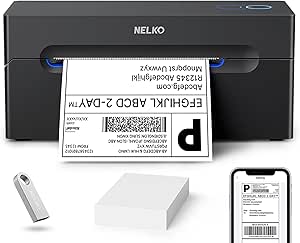
Nelko Bluetooth Thermal Shipping Label Printer, 4×6 Thermal Label Printer
Among these five, the Nelko is the clearest fit for sellers who prioritize batch throughput: its listed 72 labels per minute and capacity of up to 500 copies per run point toward longer print sessions than the JADENS, whose listed speed is 6.57 pages per minute. It prints at 203 dpi and accepts labels from 1.54 to 4.1 inches wide, so it can handle more than standard 4×6 shipping labels. Bluetooth and USB give it useful connection flexibility, but there is a platform wrinkle: Bluetooth requires an app, and Mac users are limited to USB. Labeer claims an even higher speed, but its stated sheet capacity is only 10, making the Nelko’s listed run capacity a more relevant advantage for batch work. Its speed figures are product specifications, not a guarantee for every label or setup.
Pros:- Listed speed of 72 pages per minute targets batch printing.
- Supports media widths from 1.54 to 4.1 inches.
- Maximum of 500 copies per run is suited to longer print jobs.
- Bluetooth and USB connectivity cover mobile and wired workflows.
Cons:- Bluetooth requires an app, which adds setup steps.
- Mac OS supports USB only, not Bluetooth.
- Monochrome output cannot print color labels.
Best for: Small businesses that print shipping or barcode labels in repeated batches and can use the app or USB connection their device requires.
Not ideal for: Mac users who need wireless printing, or beginners who want Bluetooth setup without app configuration.
- Printer type:Thermal
- Resolution:203 x 203 dpi
- Listed print speed:72 pages per minute
- Label width range:1.54 to 4.1 inches
- Maximum copies per run:500
- Connectivity:Bluetooth, USB
- Weight:1.4 kg
- Power:6 watts
Our verdict“Choose the Nelko for frequent batch jobs and broad label widths, provided its app-based Bluetooth setup or Mac USB connection fits your workflow.”
Labeer Bluetooth Thermal Shipping Label Printer, Wireless 4×6 Printer White
The Labeer is the most portable option here by listed weight, at 450 g, and its stated width range of 1.57 to 4.41 inches covers 4×6 labels as well as narrower formats. It also lists support for iOS, Android, Windows, macOS, and Linux, a broader platform spread than the JADENS, which is specified for smartphones, Windows, and Mac. Its advertised 100 pages per minute is the fastest listed figure in this group, but the maximum sheet capacity is only 10; that limits how useful the speed claim is for uninterrupted batch work compared with Nelko’s stated 500-copy run capacity. Bluetooth pairing may also take troubleshooting, and the printer is monochrome. This makes the Labeer a portability and device-coverage pick, rather than the safest choice for large-volume shipping.
Pros:- Listed weight of 450 g makes it the lightest option in this group.
- Supports label widths from 1.57 to 4.41 inches, including 4×6.
- Lists compatibility with iOS, Android, Windows, macOS, and Linux.
- Bluetooth and USB support wireless and wired connections.
Cons:- Maximum sheet capacity of 10 can interrupt larger print batches.
- Bluetooth pairing may present connection issues.
- Monochrome thermal output cannot print color.
Best for: Mobile sellers and home-based shippers who need a lightweight printer, varied label widths, and support across several operating systems.
Not ideal for: Businesses printing long batches without frequent reloading, or buyers who need color output and dependable Bluetooth pairing without troubleshooting.
- Printer type:Thermal
- Resolution:203 x 203 dpi
- Listed print speed:100 pages per minute
- Supported label width:1.57 to 4.41 inches
- Maximum sheet capacity:10
- Connectivity:Bluetooth, USB
- Compatible operating systems:iOS, Android, Windows, macOS, Linux
- Weight:450 g
Our verdict“Pick the Labeer for a lightweight, broadly compatible setup, but choose the Nelko instead for longer batch runs.”
Rongta Bluetooth Shipping Label Printer, Wireless 4×6 Thermal Label Printer for Shipping Packages, Support Phones, Compatible with Windows, macOS, Android, iOS for Small Business
This Rongta RP425 is the portability-focused alternative to the first Rongta in this group: it weighs 0.65 kg, has a compact listed footprint, and adds automatic label detection to help simplify loading. It supports multiple label sizes, including 4×6, so it is more adaptable than the fixed-format JADENS. Bluetooth support and compatibility with phones and computers suit a small packing station that sometimes moves or has limited space. The tradeoff is that mobile printing requires an app, and its listed maximum copy speed of 0.58 pages per minute is unusually low compared with the advertised speeds for Nelko and Labeer. Other speed fields in the supplied specifications differ, so I would not choose it on throughput claims. It makes more sense for occasional shipping where compact storage and label detection matter more than predictable batch speed.
Pros:- Automatic label detection can simplify loading and label setup.
- Supports multiple label sizes, including 4×6 shipping labels.
- Bluetooth connectivity and phone compatibility support wireless workflows.
- Listed weight of 0.65 kg and compact dimensions suit tight workspaces.
Cons:- Mobile printing requires an app.
- The listed maximum copy speed of 0.58 pages per minute is far below the Nelko and Labeer speed claims.
- Supplied speed specifications are inconsistent, making throughput hard to judge.
Best for: Small sellers with limited workspace who print occasional shipping labels from a phone or computer and value automatic label detection.
Not ideal for: High-volume shippers who need clear, consistent batch-speed specifications or buyers who want app-free mobile setup.
- Printer type:Thermal
- Resolution:203 x 203 dpi
- Connectivity:Bluetooth
- Supported media:Labels, including 4 x 6 inches
- Weight:0.65 kg
- Dimensions:3 x 7 x 2 inches
- Maximum copy speed:0.58 pages per minute
- Warranty:1 year
Our verdict“Choose this Rongta for a compact occasional-shipping station with automatic label detection, not for speed-focused batch printing.”
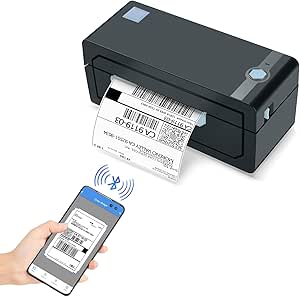
Bluetooth Shipping Label Printer with Built-in Label Bin
The built-in label bin is the main reason I’d choose this D450BT over the SVANTTO: it keeps a stack of labels housed inside the printer, which can make a small packing station feel less cluttered. It also pairs Bluetooth and USB with unusually broad stated device support, including ChromeOS and Linux, so it suits sellers working across different computers and phones. The listed capacity of 250 labels is useful for longer packing batches, while 203 DPI and a 72-label-per-minute claim put it in the practical shipping-label class. Its tradeoff is size flexibility: it supports 4×6 labels and media up to 4.6 inches, not general-purpose documents or larger formats. I’d pick it for an organized home or small-business station, not for varied print jobs.
Pros:- Built-in bin stores up to 250 labels, reducing loose-label clutter.
- Bluetooth and USB support offers wireless or wired setup options.
- Listed compatibility covers Android, iOS, Windows, macOS, Linux, and ChromeOS.
- Thermal printing avoids ink and toner replacements.
Cons:- Limited to thermal labels rather than regular documents or other print jobs.
- Media support tops out at 4.6 inches, limiting larger label formats.
- Requires compatible thermal labels.
Best for: Small online sellers who want a compact, enclosed label supply and need to print from a mix of phone and computer platforms.
Not ideal for: Buyers who need to print documents, use label formats wider than 4.6 inches, or avoid buying thermal labels.
- Printing technology:Thermal
- Connectivity:Bluetooth, USB
- Supported devices:Android, iOS, Windows, macOS, Linux, ChromeOS
- Supported labels:4 x 6 inches
- Maximum media size:4.6 inches
- Print resolution:203 x 203 DPI
- Print speed:72 labels per minute
- Built-in label capacity:250 labels
- Dimensions and weight:7.3 x 6.3 x 5.35 inches; 0.97 kg
Our verdict“Choose the D450BT if an enclosed label supply and broad device compatibility matter more than printing beyond shipping-label formats.”
SVANTTO Bluetooth Shipping Label Printer 4×6 Wireless Thermal Label Maker
The SVANTTO is the speed-focused choice in this group, with a stated rate of 180 mm per second. That makes it a better fit for sellers printing a succession of parcels than the KNAON, whose listed rate is 60 pages per minute and whose Bluetooth workflow requires its named app. The SVANTTO supports label widths from 1.57 to 4.3 inches, giving it room for narrower barcode or product labels alongside standard shipping formats. Bluetooth and USB cover phone and computer setups, and the included cable, adapter, plug, and Type-C port give buyers a useful set of connection hardware. The tradeoff is that its details don’t list a built-in label bin or print resolution, so buyers comparing desk organization or print sharpness have less information than they do for the D450BT.
Pros:- Stated print speed of 180 mm per second suits batch shipping work.
- Supports label widths from 1.57 to 4.3 inches.
- Bluetooth and USB provide wireless and wired connection choices.
- Includes USB cable, adapter, plug, and Type-C port.
Cons:- Limited to thermal label printing, not general document printing.
- Bluetooth is required for wireless use.
- Product details do not specify print resolution or a built-in label capacity.
Best for: Online sellers who print labels in batches and want stated high-speed output plus both wireless and USB connection options.
Not ideal for: Buyers who want an enclosed label compartment, a specified print resolution, or a printer for non-label documents.
- Printing technology:Thermal
- Connectivity:Bluetooth, USB
- Supported devices:Android, iOS, Windows, Mac
- Supported label widths:1.57–4.3 inches (40–110 mm)
- Print speed:180 mm per second
- Included accessories:USB cable, adapter, plug
- Port:Type-C
Our verdict“Pick the SVANTTO for speed and width flexibility, but choose the D450BT if a built-in label bin and stated resolution matter more.”
Bluetooth Thermal Shipping Label Printer, 4×6, Black
At 7.08 x 3.07 x 2.95 inches, this black printer has the slimmest listed profile here, making it a sensible pick when a shipping station has little spare desk space. Its Bluetooth and USB options offer a direct alternative to the SVANTTO’s speed-led setup, while 203 DPI and support for 4×6 media suit routine parcel labels. The important catch is device compatibility: Bluetooth is stated for Android and iOS, while PC use requires downloading drivers. That makes it less straightforward for mixed-device households than the D450BT, which lists Windows, macOS, Linux, and ChromeOS support. Its 4×6 limit also makes it a focused shipping tool rather than a flexible label printer for wider formats. Choose it for a compact, phone-centered packing area, not broad connectivity needs.
Pros:- Slim dimensions suit crowded desks and compact packing stations.
- Bluetooth and USB provide two connection methods.
- 203 DPI resolution is specified for standard thermal label printing.
- Thermal operation removes ink and toner from the routine.
Cons:- Bluetooth support is limited to Android and iOS.
- PC connection requires driver downloads.
- Maximum media size is 4×6 inches.
Best for: Phone-based home shippers or small sellers with limited desk space who primarily print standard 4×6 labels.
Not ideal for: Buyers who need Bluetooth printing from a PC, Wi-Fi connectivity, or label formats larger than 4×6 inches.
- Printer type:Thermal
- Connectivity:Bluetooth, USB
- Bluetooth compatibility:Android and iOS
- Maximum media size:4 x 6 inches
- Print resolution:203 DPI
- Print speed:72 pages per minute
- Print media:Labels, thermal paper
- Dimensions:7.08 x 3.07 x 2.95 inches
- Color:Black
Our verdict“Choose this model for a small, phone-led shipping station; the D450BT is a better match for broader computer compatibility.”
KNAON Bluetooth Thermal Shipping Label Printer, 4×6 Portable Thermal Address Label Printer for Small Business, Compatible with iPhone, Android, Windows, Mac
The KNAON stands apart from the 4×6-focused Bluetooth Thermal Shipping Label Printer by supporting shipping, barcode, and price-tag templates. Its 4.2-inch maximum media size still keeps it within a compact-label role, but that variety can help a small seller use one device for parcel labels and basic product labeling. It offers Bluetooth and USB, a 100-sheet capacity, and a stated speed of 60 pages per minute; the listed 180 mm/s figure in the product benefits also points to quick output, though the supplied speed details are not perfectly consistent. Bluetooth printing requires the FlashLabel Pro app, adding a step that the SVANTTO’s stated setup description does not call out. Its small listed dimensions are appealing, but setup may take more patience for less technical buyers.
Pros:- Supports shipping, barcode, and price-tag label uses.
- Bluetooth and USB cover wireless and wired connections.
- Compact listed dimensions suit limited work surfaces.
- Supports compatible laptops, PCs, smartphones, and tablets.
Cons:- Bluetooth printing requires the FlashLabel Pro app.
- Product details give conflicting print-speed figures.
- Maximum media size is 4.2 inches.
Best for: Small-business sellers who print shipping labels along with barcode or price labels and are comfortable using a dedicated phone app.
Not ideal for: Buyers who want the simplest Bluetooth workflow, need media wider than 4.2 inches, or expect to print non-label documents.
- Printer type:Thermal
- Connectivity:Bluetooth, USB
- Compatible devices:Laptops, PCs, smartphones, tablets
- Maximum media size:4.2 inches
- Print resolution:200 x 200
- Maximum sheet capacity:100
- Print speed:60 pages per minute; product benefits also state up to 180 mm/s
- Dimensions and weight:5.46 x 3.03 x 2.61 inches; 2.8 pounds
- Bluetooth app:FlashLabel Pro
Our verdict“Pick the KNAON for varied small-label tasks, but the SVANTTO is a cleaner choice if batch speed is your priority.”
Rongta Bluetooth Thermal Shipping Label Printer for Small Business
The Rongta’s appeal is its lightweight, compact design paired with both Bluetooth and USB, making it a simple candidate for a small shipping desk or a setup that may need to move. It prints up to 4 x 6 inches at 203 DPI, which covers standard parcel labels, and its one-year warranty is a useful detail absent from the listed specifications for the KNAON. Compared with the D450BT, though, Rongta provides no stated built-in label bin or label capacity, and its stated print rate is just 15 pages per minute. The listed dimensions are unusually small, so buyers should check that the form factor suits their intended placement. This is a basic shipping-label tool, not a flexible office printer, and it requires app or driver setup.
Pros:- Weighs 1.26 pounds, making it easy to move between work areas.
- Bluetooth and USB support wireless and wired printing.
- 203 DPI resolution and 4 x 6-inch media fit standard shipping labels.
- Includes a stated one-year warranty.
Cons:- Listed print speed is 15 pages per minute, below the SVANTTO’s stated 180 mm per second.
- Requires app or driver setup.
- Product details do not state label capacity or a built-in label bin.
Best for: Small sellers who want a lightweight thermal printer for standard 4×6 parcel labels and value a stated one-year warranty.
Not ideal for: High-volume shippers who prioritize stated batch speed, or buyers who need broader document printing and clear label-capacity details.
- Printer type:Thermal
- Connectivity:Bluetooth, USB
- Compatible devices:Laptops, PCs, smartphones, tablets
- Maximum media size:4 x 6 inches
- Print resolution:203 DPI
- Print speed:15 pages per minute
- Weight:1.26 pounds
- Dimensions:4 x 1 x 2 inches
- Warranty:1 year
Our verdict“Choose the Rongta for a lightweight, basic 4×6 setup; opt for the D450BT if you want a stated label bin and larger capacity.”
Thermal Shipping Label Printer 4×6 Bluetooth Label Maker for Small Business
This printer is a sensible fit for a small business that wants to make shipping labels from either a computer or a phone. Bluetooth and USB connectivity give it more setup flexibility than the KNAON Shipping Thermal Label Printer, whose Bluetooth printing depends on its FlashLabel Pro app. Here, the customizable app templates and offline storage can help with repeat label layouts, while the stated compatibility with major shipping platforms suits routine order fulfillment. Its 203 DPI resolution is standard for this group, and the listed speed of up to 72 labels per minute suggests it is designed for batches rather than one-off home use. The tradeoff is a reliance on the app for full functionality, plus black-and-white output only. I would choose it over the Phomemo 241BT when template customization is the priority, but not for color labels or buyers who want to avoid app-dependent features.
Pros:- Bluetooth and USB support printing from phones and computers
- Customizable app templates and offline storage can help with recurring label formats
- 203 DPI thermal output avoids ink and toner
- Supports 4×6-inch labels and widths from 1.57 to 4.3 inches
Cons:- Full functionality requires the companion app
- Prints only in monochrome
- The listed maximum speed and copy-run capacity may not reflect every real-world shipping workflow
Best for: Small-business sellers who regularly print shipping labels and want phone-based templates alongside a USB computer connection
Not ideal for: Buyers who need color output, prefer app-free workflows, or need a clearly stated operating-system list before purchase
- Printer type:Direct thermal
- Resolution:203 × 203 dpi
- Maximum print speed:72 labels per minute
- Connectivity:Bluetooth and USB
- Supported label width:1.57–4.3 inches, including 4×6 inches
- Dimensions:8.08 × 4.73 × 6.9 inches
- Weight:3 pounds
- Compatible devices:Laptops, Mac, PC, smartphones, and tablets
Our verdict“Choose this model if your small business values app-based templates and both wireless and USB printing more than color output or an app-free setup.”
KNAON Shipping Thermal Label Printer, 4×6 Portable Label Printer, White
The KNAON is the most space-conscious choice in this group, with a slim 7.3 × 2.56 × 3.15-inch body suited to a crowded desk or a printer that needs to move between work areas. Its stated speed of up to 180 mm/s is useful for getting labels out quickly, though it is not directly comparable to the labels-per-minute figures listed for some other models. Like the Labeer Bluetooth Thermal Shipping Label Printer, it offers Bluetooth and USB, but KNAON specifies compatibility across Windows, macOS, Android, and iOS. That broad device support makes it versatile, while the requirement to use the FlashLabel Pro app for Bluetooth printing adds a setup dependency. Its 4.41-inch maximum media size is ample for standard 4×6 shipping labels, but gives less width flexibility than the Labeer’s listed range. Skip it if you want an app-free wireless workflow.
Pros:- Compact dimensions suit small workspaces and portable setups
- Bluetooth and USB connections support phone and computer workflows
- Compatibility includes Windows, macOS, Android, and iOS
- Listed print speed reaches 180 mm/s
Cons:- Bluetooth printing requires the FlashLabel Pro app
- Monochrome output cannot produce color labels
- Maximum media size of 4.41 inches limits wider label options
Best for: Home shippers and small sellers with limited desk space who print standard 4×6 labels from phones or computers
Not ideal for: Users who want Bluetooth printing without a required companion app or who need media wider than 4.41 inches
- Printer type:Thermal
- Resolution:203 dpi
- Print speed:Up to 180 mm/s
- Connectivity:Bluetooth and USB
- Maximum media size:4.41 inches
- Paper size:4 inches
- Dimensions:7.3 × 2.56 × 3.15 inches
- Compatible devices:Laptops, PCs, smartphones, and tablets
Our verdict“Pick the KNAON for a tight workspace and standard shipping labels if the required app fits your phone-based workflow.”
Phomemo Bluetooth Thermal Label Printer, 241BT with 20 Labels
The Phomemo 241BT earns its place for buyers who need a shipping-label printer that works across an unusually broad range of computer systems: the listing names iOS, Android, Windows, Mac, Chrome OS, and Linux. That makes it a more flexible choice for mixed-device households or small teams than the Thermal Shipping Label Printer 4×6 Bluetooth Label Maker for Small Business, whose compatible-device list is broad but less specific about operating systems. It supports Bluetooth and USB, prints up to 4×6 inches, and includes an OLED display; the display can provide a more direct control point than the app-only control method listed for this model. The stated speed of 66 pages per minute is not an apples-to-apples comparison with label-per-minute or mm/s claims elsewhere. Its limits are monochrome-only output and reliance on compatible thermal labels, so it suits shipping and barcode work rather than color or general document printing.
Pros:- Listed compatibility spans six major operating systems
- Bluetooth and USB offer wireless and wired connection options
- Supports standard 4×6-inch shipping labels
- OLED display provides a control feature alongside app operation
Cons:- Prints only in black and white
- Requires compatible thermal label paper for best results
- The listed 66-pages-per-minute speed may not translate directly to shipping-label throughput
Best for: Small sellers and households using a mix of Linux, Chrome OS, Mac, Windows, Android, or iOS devices
Not ideal for: Buyers who need color labels, general-purpose document printing, or a clearly stated warranty beyond the listed return guarantee
- Printer type:Thermal
- Resolution:203 × 203 DPI
- Maximum media size:4 × 6 inches
- Listed print speed:66 pages per minute
- Supported operating systems:iOS, Android, Mac OS, Windows, Chrome OS, and Linux
- Control method:App
- Display:OLED
- Weight:720 g
Our verdict“Choose the 241BT when broad operating-system support matters more than color printing or a clearly specified long-term warranty.”
Labeer Bluetooth Thermal Shipping Label Printer, Wireless 4×6 Label Printer
The Labeer stands out for sellers who switch between parcel labels and smaller barcode or inventory tags. Its listed supported widths run from 1.57 to 4.41 inches, with formats including 4×6, 4×4, 4×2, and 2×1; that gives it more clearly stated size variety than the KNAON, which tops out at 4.41 inches but does not list the same range of formats. Bluetooth and USB cover phone and computer setups, while automatic calibration and jam detection may help reduce interruptions when changing label jobs. At 450 g, it is also a lightweight option for a home office or packing station. The tradeoff is its 50-sheet capacity, which may require more frequent replenishment than the Phomemo 241BT’s listed 500-sheet capacity. It remains monochrome and needs compatible thermal labels, so I would favor it for varied label tasks, not the longest uninterrupted batches.
Pros:- Supports several listed formats, including 4×6, 4×4, 4×2, and 2×1
- Bluetooth and USB support wireless and wired printing
- Automatic calibration and jam detection can simplify label changes
- Lightweight 450 g design suits compact work areas
Cons:- Listed maximum sheet capacity is 50, below the Phomemo 241BT’s stated 500
- Monochrome thermal printing cannot create color labels
- Requires compatible thermal labels for best performance
Best for: Small businesses that alternate between 4×6 shipping labels and smaller barcode, inventory, or product tags
Not ideal for: High-volume shippers who want fewer media reloads or buyers who need color labels
- Printer type:Thermal
- Resolution:203 × 203 dpi
- Maximum media size:4×6 inches
- Supported label widths:1.57–4.41 inches
- Listed label formats:4×6, 4×4, 4×2, and 2×1
- Connectivity:Bluetooth and USB
- Weight:450 g
- Maximum sheet capacity:50
Our verdict“Pick the Labeer if you print several label sizes at one station, but choose a higher-capacity option for long shipping batches.”

How We Picked
I ranked these printers around the needs behind the search: printing standard shipping labels without ink, connecting to the devices a seller already uses, and fitting the seller’s packing routine. I gave more weight to clearly stated compatibility, a recognizable 4×6 shipping-label focus, and useful workflow details than to broad claims such as “wireless” or “for small business.” A feature only helps when its limits are clear enough for a buyer to match it to a device, label supply, and shipping platform.
The ranking favors products with more specific, decision-useful information. That puts the multi-platform Rongta listing first, while the built-in-bin model and Phomemo 241BT earn distinct consideration for storage and included starter labels. Products with less detail remain viable candidates, but I rank them lower because the supplied listings do not establish meaningful differences in compatibility, roll handling, setup, or maintenance. I do not infer print speed, app quality, reliability, or premium build from product names alone; buyers should check the exact listing before purchase.
| label printer thermal shipping | Printer type | Connectivity |
|---|---|---|
| Rongta Shipping Thermal Label | Thermal | Bluetooth, USB |
| JADENS Bluetooth Thermal Shipp | Thermal | Bluetooth, USB |
| Nelko Bluetooth Thermal Shippi | Thermal | Bluetooth, USB |
| Labeer Bluetooth Thermal Shipp | Thermal | Bluetooth, USB |
| Rongta Bluetooth Shipping Labe | Thermal | Bluetooth |
| Bluetooth Shipping Label Print | — | Bluetooth, USB |
| SVANTTO Bluetooth Shipping Lab | — | Bluetooth, USB |
| Bluetooth Thermal Shipping Lab | Thermal | Bluetooth, USB |
| KNAON Bluetooth Thermal Shippi | Thermal | Bluetooth, USB |
| Rongta Bluetooth Thermal Shipp | Thermal | Bluetooth, USB |
| Thermal Shipping Label Printer | Direct thermal | Bluetooth and USB |
| KNAON Shipping Thermal Label P | Thermal | Bluetooth and USB |
| Phomemo Bluetooth Thermal Labe | Thermal | — |
| Labeer Bluetooth Thermal Shipp | Thermal | Bluetooth and USB |
Factors to Consider When Choosing Label Printer Thermal Shipping
A 4×6 thermal printer can simplify shipping, but the right choice depends on how labels reach the printer and how often you print. I would settle compatibility and label handling before choosing by color, portability, or a broad small-business claim.
Match the printer to your actual device and shipping workflow
Bluetooth support does not automatically mean a printer will work with every phone, computer, or shipping service. Before buying, check the exact operating-system versions supported and whether the printer uses a dedicated app, computer driver, or both. Sellers who create postage on a laptop may prioritize desktop support, while phone-first sellers need to confirm that their shipping platform can send labels to the printer through its app. A compatibility list should name your device rather than rely on a general “iOS” or “Android” label. If you use multiple devices, check whether switching between them is supported and how pairing works. This step can prevent a printer that connects successfully but cannot print from your label source.
Check label size, roll format, and feed arrangement
Many shipping labels use the familiar 4×6 format, but the printer must also accept the label stock you plan to buy. Look for the supported width range and whether labels feed from an internal compartment, an external roll, or fanfold stacks. A built-in bin can reduce desk clutter, but its dimensions may restrict roll size or capacity; confirm both before treating it as a convenience. External rolls can suit higher-volume shipping, though they need space behind or beside the printer. Avoid assuming that a printer’s 4×6 label description means every 4×6 roll is compatible. Verify the recommended label type and whether gap or black-mark sensing matches your stock.
Think about volume and the whole packing station
A seller printing a few parcels each week has different needs from a shop processing orders in batches. For occasional use, easy setup and simple label loading may matter more than storage capacity; at higher volume, feed consistency, roll capacity, and convenient access to supplies become more important. Consider where the printer will sit, how much room a roll needs, and whether it will stay paired to one device. A compact printer may save desk space but still require room for a roll or a stack of labels. Do not judge capacity from a product photo alone; check stated dimensions and the supported supply arrangement. Matching the physical setup to your packing routine reduces interruptions during dispatch.
Compare included supplies with ongoing label needs
An included starter pack can help you confirm the setup and print a few initial labels, but it should not drive a long-term purchase decision. The Phomemo 241BT listing includes 20 labels, which is a useful first-run detail rather than a supply plan for regular shipping. Before ordering any printer, check whether compatible labels are easy to source and whether the model requires a particular roll or format. Thermal printing avoids ink cartridges, but labels remain a recurring consumable. Compare supply availability and storage needs as well as the printer itself. A small upfront bundle is less useful if replacement stock is hard to match.
Separate verified features from broad product claims
Listings that call a printer “wireless,” “portable,” or suitable for small businesses may leave out the details that decide whether it fits your setup. Check for named operating systems, supported label dimensions, connection method, and instructions for calibration or driver installation. Similar product names in this roundup do not prove that models share hardware, apps, or accessories. Where those details are missing, ask the seller or consult the product documentation before ordering. This matters especially when comparing the two Labeer listings and multiple Rongta options, whose names alone do not show their differences. Specific compatibility and supply information is more useful than a long feature list without limits.
Decide what convenience is worth paying for
Spend more only when a specific feature solves a recurring problem in your workflow. A built-in label bin may be worthwhile if exposed rolls create clutter, while broad device compatibility may help a team that prints from different platforms. If you print occasionally from one computer, those extras may add little; a straightforward 4×6 model with confirmed compatibility could be a better fit. Think about setup time, available desk space, and the cost and availability of label stock alongside the printer’s features. Do not assume that a premium-sounding name means better build quality or support without clear documentation. Choose by the cost of the complete shipping setup, not by one headline feature.
Frequently Asked Questions
Will any Bluetooth thermal shipping printer work with my iPhone and shipping app?
No. Bluetooth describes a connection method, not universal compatibility with every iPhone app or shipping platform. Check that the exact printer supports your iOS version and that your label source can print to it, either directly or through the printer maker’s app. Also confirm whether setup requires a separate driver or account. The Rongta Shipping Thermal Label Printer listing names iOS support, but buyers should still verify their app and model details before ordering.
Should I choose a printer with a built-in label bin or an external roll holder?
Choose based on your desk layout and label volume rather than assuming one feed style is universally better. A built-in bin can keep a roll enclosed and reduce clutter, but the listing’s supported roll dimensions and capacity matter. An external holder may allow a larger supply or a different stock arrangement, though it needs room beside or behind the printer. Check how labels are loaded and whether your preferred stock is supported. If those specifications are not stated, ask before buying.
Are the two Rongta or two Labeer listings interchangeable?
The product names alone do not establish that the listings use the same hardware, software, or accessories. One Rongta listing specifically names Windows, macOS, Android, and iOS, while other similarly named entries provide less detail in their titles. The two Labeer entries also have overlapping descriptions, so a name match is not enough to compare them. Check the exact model number, compatibility list, label-feed design, and included items on each listing. If those details are unclear, treat them as separate options until confirmed.
Is the Phomemo 241BT’s included pack enough to start shipping orders?
The listing includes 20 labels, which can help with initial setup or a small number of shipments. It is not a dependable supply for ongoing business use, so check the availability and format of replacement labels before committing. Confirm that the included labels match your usual shipping-label size and that your shipping platform can send a compatible print file. For a launch or occasional seller, the starter quantity may be convenient; a busier shop should plan for additional stock right away. Treat included labels as a setup bonus, not a sign of long-term capacity.
What should I verify before buying a printer for a high-volume shipping desk?
Look beyond the 4×6 description and check supported roll capacity, feed arrangement, and how easily labels can be reloaded. Confirm that the printer works with the computer or devices used by everyone on the packing team, not just the owner’s phone. Ask whether the model supports the label stock you intend to buy and whether calibration or driver steps are needed after a roll change. Also review the manufacturer’s documentation for maintenance and connection troubleshooting. The listings here do not provide enough information to rank print speed or duty cycle confidently, so seek those specifications directly if volume is a major factor.
Conclusion
For most small sellers, my best overall choice is the Rongta Shipping Thermal Label Printer because its listing names support for four major device platforms. The best value in practical convenience is the Phomemo 241BT if a small included label supply helps you get started, though it is not a substitute for checking ongoing stock. For beginners, I would choose whichever printer has clear instructions and confirmed support for the device and shipping app already in use; the Rongta listing is the clearest starting point on compatibility. The best specific-workflow pick is the Built-in Label Bin model for buyers who want enclosed roll storage, after checking capacity and roll fit. No supplied listing establishes a clear best premium option, so I would not pay extra based on a premium label alone: seek documented build, support, and volume specifications first. If a printer’s compatibility or label-feed details remain vague, choose a better-documented model rather than guessing.