
For a portable power station for car camping, I’d start with the Jackery Explorer 1000 v2 as the best overall fit here: its 1,070Wh capacity and 1,500W output offer more room for multi-device trips than the smaller units. The Anker SOLIX C300 is a compelling middle ground for campers who want a familiar 288Wh class without carrying a full-size station, while the Jackery Explorer 300 is a straightforward option for basic charging. The tradeoff is simple: more capacity can run larger loads for longer, but it adds bulk, while compact models are easier to pack but limit what you can power. I’ll compare all 14 picks by capacity, output, portability, and camping use so you can match a station to your gear and trip length.

Turn the school run and nap time into listening time
- Thousands of audiobooks, podcasts and originals
- Listen on your phone, tablet or Echo — also offline
- Cancel anytime
Complete the kit


Key Takeaways
- The Jackery Explorer 1000 v2 is the capacity leader in this group: its 1,070Wh battery and 1,500W output give it a different role from the many 192–300Wh options, which are better suited to light loads.
- Most of the lineup clusters around 300W and roughly 200–300Wh: that class can cover phones, lights, and some small electronics, but a wattage label alone does not tell you how long they can run.
- Battery chemistry varies even among similarly sized units: the ALLWEI and DaranEner listings specify LiFePO4, while capacity and output still need to be weighed against weight and port selection.
- The smallest models trade flexibility for packability: the Daran 89.6Wh and MARBERO 88Wh are better matched to personal electronics than to long stays or several power-hungry devices.
- Solar claims need careful comparison: only one listing explicitly includes a 60W panel, and a panel’s rated output does not guarantee fast recharging at a campsite; sunlight, placement, and station input limits all matter.




| portable power station for car camping | Weight | Dimensions | Battery type | Capacity |
|---|---|---|---|---|
| Jackery Explorer 1000 v2 Porta | 23.8 pounds | 12.87 × 8.82 × 9.72 inches | LFP | 1070Wh |
| ALLWEI Portable Power Station | 6.4 pounds | 9.25 × 5 × 6.81 inches | LiFePO4 | 256Wh |
| DaranEner Portable Power Stati | 5.73 pounds | — | LiFePO4 | 192Wh |
| EnginStar Solar Generator | 6.5 pounds | 9 × 5.5 × 7.5 inches | — | 296Wh |
| BailiBatt Portable Power Stati | 6.5 pounds | 8.66 × 8.66 × 7.87 inches | — | 266Wh |
| Portable Solar Generator 300W | — | — | Lithium-ion | — |
| Portable Power Station 300W | 8.8 lb | 5.9 x 9.4 x 7.3 in | LiFePO4 | 192Wh |
| HOWEASY Portable Power Station | 2.3 lb | 6.6 x 3 x 4 in | — | — |
| Daran Portable Power Station 8 | 2.54 lb | 6.5 x 3.3 x 4 in | LiFePO4 | — |
| Anker SOLIX C300 Portable Powe | 4.13kg | 6.46 x 6.34 x 9.45 in | LiFePO4 | 288Wh |
| Bailibatt Portable Power Stati | 4.6 lbs | 8 × 4 × 6.5 in | — | — |
| EnginStar Portable Power Stati | — | — | — | — |
| MARBERO Portable Power Station | 1.04kg (about 2.3 lbs) | 6.5 × 4.6 × 3.1 in | Cylindrical cells meeting UL safety standards | — |
| Jackery Explorer 300 Portable | 7.5 lbs | 9.1 × 5.2 × 7.8 in | — | — |
More Details on Our Top Picks
Jackery Explorer 1000 v2 Portable Power Station, 1070Wh, 1500W
I’d put the Jackery Explorer 1000 v2 first for car campers who want to run more than phones and lights. Its 1070Wh capacity and 1500W continuous output give it far more headroom than the 300W, sub-300Wh options here, including the ALLWEI and EnginStar. That means more flexibility for compatible appliances and longer stretches between recharges, though actual runtime depends on the device and load. At 23.8 pounds, it is portable from car to campsite, but not the grab-and-go choice for a backpack or a minimalist setup. The LFP battery and fast AC charging suit frequent trips; the tradeoff is that solar panels are sold separately and solar compatibility is limited to Jackery panels. I’d skip it if you only need USB charging, since smaller stations are easier to carry.
Pros:- 1070Wh capacity offers substantially more stored energy than the compact 192–296Wh stations in this group.
- 1500W continuous output supports a wider range of compatible appliances than 300W models.
- LFP battery is specified for over 10 years of use.
- Fast AC charging can reduce downtime between trips.
Cons:- At 23.8 pounds, it is much heavier than the 5.73–6.5-pound compact options.
- Solar panel is not included, and the listed solar compatibility is limited to Jackery panels.
- Certain fast-charging features require the app.
Best for: Car campers who want substantial stored energy and enough output for compatible higher-draw campsite appliances.
Not ideal for: Minimalist campers who only charge phones and lights, or anyone prioritizing a light station and an included solar panel.
- Capacity:1070Wh
- Continuous output:1500W
- Peak starting wattage:3000W
- Battery type:LFP
- Total power outlets:7
- Weight:23.8 pounds
- Dimensions:12.87 × 8.82 × 9.72 inches
Our verdict“Choose the Jackery if longer car-camping trips and higher output matter more than keeping your power station especially light.”
ALLWEI Portable Power Station 300W, 256Wh Solar Generator LiFePO4 Battery
The ALLWEI 256Wh is a practical middle ground for car campers who want a compact station without dropping to the DaranEner’s 192Wh capacity. Its 300W continuous output fits modest loads such as phones, lights, and other compatible small electronics, but it is not a substitute for the Jackery Explorer 1000 v2 when appliances need more power or longer run time. I like the range of AC, car, and solar charging options for trips where access to an outlet varies. At 6.4 pounds, it is easy to move between the trunk and campsite, and its LiFePO4 battery is listed for 3,000 cycles. The compromise is the same one common to compact stations: limited capacity and output. Charging can also take a while with some methods, so I’d plan ahead rather than count on a quick top-up at camp.
Pros:- 256Wh capacity is higher than the DaranEner’s 192Wh while staying compact.
- 300W continuous output suits many small camping electronics.
- Supports AC, car, and solar recharging.
- LiFePO4 battery is specified for 3,000 charge cycles.
Cons:- 300W output rules out many higher-power appliances.
- Charging can be lengthy with some charging methods.
- Solar panels are not listed as included.
Best for: Car campers who need a portable source for small electronics and want AC, car, and solar recharge options.
Not ideal for: Campers planning to power high-draw appliances or needing the longer reserve offered by the Jackery Explorer 1000 v2.
- Capacity:256Wh
- Continuous output:300W
- Peak surge power:600W
- Battery type:LiFePO4
- Charge cycles:3000
- Output ports:AC, DC5521, car cigarette lighter, USB-A, USB-C
- Weight:6.4 pounds
- Dimensions:9.25 × 5 × 6.81 inches
Our verdict“Pick the ALLWEI for a portable, recharge-flexible station serving modest camp loads rather than appliance-heavy setups.”
DaranEner Portable Power Station, 192Wh LiFePO4 Battery Backup Solar Generator
At 5.73 pounds, the DaranEner is the lightest option in this five-product group, making it a sensible choice when trunk space and easy handling matter more than long runtimes. Its 192Wh capacity is the smallest here, below both the ALLWEI and BailiBatt, so I’d reserve it for phones, cameras, lights, and similar modest loads rather than several nights of broad power use. Two AC outlets and 60W USB-C PD give it useful flexibility for a compact station, while AC, car, and solar charging suit road trips. The stated 3500+ cycle life is a plus for repeat use. Compared with the EnginStar’s 296Wh, though, this model gives up a meaningful amount of stored energy. Solar panels and car cables are not included, adding gear to source separately.
Pros:- At 5.73 pounds, it is lighter than the other listed stations in this batch.
- 60W USB-C PD supports faster charging for compatible devices.
- Two AC outlets add flexibility for small electronics.
- LiFePO4 battery is rated for 3500+ cycles.
Cons:- 192Wh capacity is lower than the ALLWEI, BailiBatt, and EnginStar.
- 300W continuous output cannot support higher-power appliances.
- Solar panel and car-charging cables are not included.
Best for: Light-packing car campers who mainly need to recharge personal electronics and want a compact LiFePO4 station.
Not ideal for: Campers who need multiple days of reserve, want to run appliances above 300W, or expect included solar and car-charging accessories.
- Capacity:192Wh
- Continuous output:300W
- Surge output:600W
- Battery type:LiFePO4
- AC outlets:2
- USB-C PD:60W
- Weight:5.73 pounds
- Solar input:Up to 60W
Our verdict“Choose the DaranEner when low carry weight matters more than battery capacity or powering larger campsite gear.”
EnginStar Solar Generator, 300W Portable Power Station, 296Wh Lithium Battery Backup
The EnginStar stands out among the compact choices for offering 296Wh of capacity while staying at 6.5 pounds. That gives it more stored energy than the ALLWEI’s 256Wh and the DaranEner’s 192Wh, without moving into the heavier, higher-output class of the Jackery Explorer 1000 v2. For car camping, that extra reserve can stretch small-device charging and lighting, but its 300W output still limits it to compatible modest loads; it won’t turn a compact station into an appliance power source. Eight outlets and charging by AC, car, or solar add flexibility, and the listed protection features cover overload, short circuit, temperature, and charging conditions. Solar panels are sold separately, so off-grid recharging requires extra equipment. I’d choose it over the DaranEner for capacity, not for lighter carry weight.
Pros:- 296Wh capacity exceeds the ALLWEI and DaranEner capacities in this batch.
- Eight power outlets provide multiple connection options.
- Supports AC, car, and solar recharging.
- Listed protection includes overload, short circuit, over-discharge, overcharge, and overheating.
Cons:- 300W maximum output limits use with higher-power appliances.
- Solar panel is sold separately.
- At 6.5 pounds, it is heavier than the DaranEner.
Best for: Car campers who want more capacity than the smallest stations provide while keeping weight around 6.5 pounds.
Not ideal for: Campers who need high-wattage appliance support or want a solar panel bundled with the station.
- Capacity:296Wh
- Maximum output:300W
- AC outlets:2
- Total power outlets:8
- Voltage:110V
- Frequency:60Hz
- Weight:6.5 pounds
- Dimensions:9 × 5.5 × 7.5 inches
Our verdict“Choose the EnginStar if you want near-300Wh capacity in a compact station and can work within its 300W output ceiling.”
BailiBatt Portable Power Station 300W, 266Wh Solar Generator
The BailiBatt makes the most sense for campers who regularly charge several personal devices and want a clear display to check the station’s status. Its 266Wh capacity sits between the ALLWEI’s 256Wh and EnginStar’s 296Wh, while its dual USB-C PD ports give it a more specific appeal than those capacity-focused rivals. At 6.5 pounds, it remains manageable for car-to-campsite carrying, but the 300W ceiling keeps it in the small-electronics category, not the Jackery Explorer 1000 v2’s appliance-ready tier. The pure sine wave output is listed for sensitive devices, and the built-in flashlight with SOS mode may be handy after dark. The product data cites five hours of runtime without specifying the load, so I wouldn’t treat that as a fixed expectation. Solar panels are sold separately.
Pros:- Dual USB-C PD ports support charging two compatible devices at once.
- 266Wh capacity is slightly higher than the ALLWEI’s 256Wh.
- Pure sine wave AC output is specified.
- Built-in display and flashlight with SOS mode add useful campsite visibility and status information.
Cons:- 300W maximum output limits it to modest loads.
- 266Wh is less capacity than the EnginStar’s 296Wh.
- Solar panel is sold separately, and the stated five-hour runtime does not specify a load.
Best for: Car campers who charge multiple USB-C devices and want an onboard display and emergency light in a compact station.
Not ideal for: Campers who need to run high-wattage appliances, need substantially more than 266Wh, or expect a solar panel included.
- Capacity:266Wh
- Maximum output:300W
- Voltage:110V
- Outputs:7
- USB-C PD ports:2 (24W + 18W)
- AC output:Pure sine wave
- Weight:6.5 pounds
- Dimensions:8.66 × 8.66 × 7.87 inches
Our verdict“Pick the BailiBatt if USB-C device charging and a built-in display matter more than maximum compact-station capacity.”
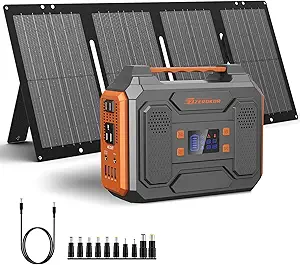
Portable Solar Generator 300W with 60W Solar Panel
This is the easiest pick in this group for car campers who want to start with solar without matching a station to a separate panel. The included 60W foldable panel and AC, car, and solar charging options offer flexibility at camp, while the 300W output can handle small electronics and modest appliances within its limit. Compared with the Anker SOLIX C300, it offers a panel in the box, but the Anker provides more stated battery capacity at 288Wh and a broader set of USB-C charging options. The tradeoff is that this unit’s battery capacity isn’t specified here, making it harder to estimate device runtimes. Its panel also depends on decent sunlight, and the junction box needs dry storage. I’d choose it for a simple solar-ready setup, not for running high-draw camp appliances.
Pros:- Includes a 60W foldable monocrystalline solar panel.
- Can recharge from AC, car power, or solar.
- Offers two AC outlets and several USB ports for small-device charging.
- Lists short-circuit, over-current, over-voltage, overload, and overheating protections.
Cons:- Battery capacity is not specified in the supplied product data, limiting runtime comparisons.
- Output is capped at 300W, ruling out many high-draw appliances.
- Solar charging can decline in low light, and the junction box is not waterproof.
Best for: Car campers who want a ready-to-use solar panel included for topping up small devices during sunny trips.
Not ideal for: Campers who need predictable runtimes, plan to use high-wattage appliances, or may leave the solar panel junction box exposed to rain.
- Power output:300W
- Solar panel:60W foldable monocrystalline
- Battery type:Lithium-ion
- AC outlets:2
- USB ports:3 USB ports and 1 quick-charge USB port
- DC port:1
- Conversion efficiency:20.5%
- Protection features:Short circuit, over-current, over-voltage, overload, overheating
Our verdict“Choose this if an included solar panel matters more than clearly specified capacity or extra USB-C power.”
Portable Power Station 300W, 600W Surge Solar Generator 192Wh
For a short car-camping stop between drives, the standout is fast AC recharging: the listing says it reaches 80% from empty in an hour. That can be more useful than a larger battery if you have access to a wall outlet before leaving or between outings. Its 192Wh LiFePO4 battery, 8.8-pound weight, and 300W output suit phones, lights, and smaller electronics, but offer less stored energy than the Anker SOLIX C300 at 288Wh. The built-in UPS is aimed at uninterrupted backup power, a feature many car campers may rarely need. Solar charging is supported, but the panel is sold separately. I’d pick this over the included-panel 300W Solar Generator when quick AC top-ups matter more than arriving with solar hardware already in the box.
Pros:- Listed AC recharge time reaches 80% in one hour.
- LiFePO4 battery is rated for 4,000+ charge cycles.
- At 8.8 pounds, it is portable for car-to-campsite trips.
- Includes USB-C PD, two AC outlets, USB-A, and a car outlet.
Cons:- The 192Wh capacity is lower than the Anker SOLIX C300’s 288Wh.
- Solar panel is sold separately.
- 300W output is not suited to high-wattage appliances such as coffee makers or hair dryers.
Best for: Campers who can recharge from AC before or between trips and want a lightweight station with a stated fast-recharge time.
Not ideal for: Travelers who need multi-day power for larger devices or want a solar panel included in the purchase.
- Capacity:192Wh
- Surge power:600W
- Battery type:LiFePO4
- Charge cycles:4,000+
- Weight:8.8 lb
- Dimensions:5.9 x 9.4 x 7.3 in
- Ports:2 AC outlets, 1 USB-C PD, 2 USB-A, 1 car outlet
- AC recharge time:1 hour from 0% to 80%
Our verdict“Pick this for quick AC refills and modest camp loads, but choose a higher-capacity station for longer stretches away from charging.”
HOWEASY Portable Power Station, 120W (240W Peak) Solar Generator
At 2.3 pounds, this HOWEASY is the easiest station here to carry from the car to a picnic table or tent. Its 120W output and multiple ports fit a narrow job: keeping phones, lights, and other modest electronics powered, rather than running appliances. Compared with the Daran 89.6Wh LiFePO4, this model lists a higher 120W output but does not provide battery capacity in the supplied specs, so it is harder to judge how long it will keep devices running. The stated runtime is about four hours at full load, and the solar panel is not included. Its LED light and AC, car, and solar charging options add convenience, but buyers who need a 300W-class station should look to the Anker SOLIX C300 or the 300W models instead. I’d choose this for weight-sensitive, low-draw trips.
Pros:- Weighs just 2.3 pounds and has a hidden handle.
- Supports solar, AC, and car-socket recharging.
- Built-in LED light has multiple modes for camp or emergency use.
- Lists eight total power outlets.
Cons:- 120W running output rules out many appliances and is well below 300W options such as the Anker SOLIX C300.
- Solar panel is not included.
- Supplied specs do not state battery capacity, and the listed full-load runtime is about four hours.
Best for: Minimalist car campers who prioritize a very light station for phones, lights, and other low-wattage gear.
Not ideal for: Campers who want to run appliances above 120W, need a stated battery capacity for planning, or expect solar hardware in the box.
- Running output:120W
- Peak output:240W
- Weight:2.3 lb
- Dimensions:6.6 x 3 x 4 in
- Total outlets:8
- Recharge methods:Solar, AC, car socket
- Runtime:Approximately 4 hours
- Cycle life:More than 1,500 charges
Our verdict“Choose this for light-duty charging when low carry weight matters more than capacity or appliance support.”
Daran Portable Power Station 89.6Wh LiFePO4 Battery 100W (200W Peak) Solar Power Bank
The Daran is a compact backup for a phone, headlamp, or laptop accessory—not a small version of a full campsite power hub. At 2.54 pounds and 89.6Wh, it takes up little room in a car-camping kit, while its LiFePO4 battery is listed for more than 3,500 cycles. Its 100W maximum output is lower than the HOWEASY’s 120W and far below the Anker SOLIX C300‘s 300W, so it suits smaller electronics rather than appliance use. Seven outlets, including two AC and two USB-C ports, make sharing power easier, but the modest capacity limits how many devices it can support for long. Solar hardware is not included. I’d pick it over the HOWEASY for its specified LiFePO4 capacity and cycle life, but not when runtime is the priority.
Pros:- Compact 89.6Wh LiFePO4 battery with a listed cycle life over 3,500 cycles.
- Weighs 2.54 pounds and measures 6.5 x 3.3 x 4 inches.
- Seven outlets include two USB-C ports and two AC outlets.
- Quiet operation and a built-in LED flashlight suit overnight camp use.
Cons:- 100W maximum output is lower than the HOWEASY’s 120W and far below 300W-class stations.
- 89.6Wh capacity limits runtime for multiple devices or longer trips.
- Solar panel is not included.
Best for: Car campers who want a pocketable LiFePO4 backup for phones, small electronics, and occasional low-draw AC use.
Not ideal for: Campers who need to power appliances above 100W, recharge several devices over multiple days, or want an included solar panel.
- Battery capacity:89.6Wh
- Battery type:LiFePO4
- Maximum output:100W
- Peak output:200W
- Total outlets:7
- Ports:2 AC outlets, 2 USB-C, 2 USB-A, 1 DC5521
- Weight:2.54 lb
- Dimensions:6.5 x 3.3 x 4 in
- Voltage:110V
Our verdict“Choose the Daran for a compact LiFePO4 backup for small electronics, not as the main power source for a campsite.”
Anker SOLIX C300 Portable Power Station, 288Wh Solar Generator for Camping
The Anker SOLIX C300 is the strongest fit here for campers who want a well-equipped 300W station with more stored energy than the other specified compact options. Its 288Wh LiFePO4 battery exceeds the 192Wh capacity of the other 300W station in this batch, giving you more room for device charging between recharges. The port mix is a standout: three AC outlets and two 140W USB-C ports can serve several devices, including compatible high-power USB-C gear. Compared with the 60W-panel Solar Generator, the Anker offers more clearly stated capacity and USB-C capability, but its solar panel is not included in the supplied data. At 4.13kg, it is also heavier than the 8.8-pound 192Wh model, and the stated 50-minute runtime applies to full load, not typical mixed use. Its 300W ceiling still rules out many appliances.
Pros:- 288Wh capacity is higher than the 192Wh 300W station in this batch.
- Two USB-C ports are rated at 140W each, alongside a separate 15W USB-C port.
- Three AC outlets and a car socket provide a versatile port selection.
- LiFePO4 battery chemistry is suited to repeated charge cycles.
Cons:- At 4.13kg, it is heavier than the 8.8-pound 192Wh model.
- The listed runtime is 50 minutes at full load, so high draw drains the battery quickly.
- Solar panel compatibility has limits, and a shoulder strap is sold separately.
Best for: Car campers who want a higher-capacity 300W station with fast USB-C charging and several AC outlets for shared device charging.
Not ideal for: Campers seeking the lightest option, an included solar panel, or power for appliances that exceed 300W.
- Capacity:288Wh
- Surge output:600W
- Battery type:LiFePO4
- AC outlets:3
- USB-C ports:2 x 140W and 1 x 15W
- Weight:4.13kg
- Dimensions:6.46 x 6.34 x 9.45 in
- Runtime:50 minutes at full load
Our verdict“Choose the C300 for greater stated capacity and a strong port selection in a 300W class station, provided its weight and solar-panel limits suit your setup.”
Bailibatt Portable Power Station 300W, 257Wh, Lightweight Solar Generator
At 4.6 pounds, this Bailibatt is the easiest pick here to move between the car, picnic table, and tent. Its 257Wh capacity and 300W limit suit phones, lights, and other modest loads, but leave less reserve than the 296Wh EnginStar or 292Wh Jackery Explorer 300. The two AC outlets and mix of USB and 12V outputs make it practical when several small devices need charging at once. I’d choose it over those heavier-capacity alternatives when reducing carried weight matters more than squeezing out extra runtime. The tradeoff is a relatively small energy reserve for multi-night use, and solar charging requires a separately purchased panel. It is not a fit for high-wattage appliances or campers expecting to power a broad set of gear for days.
Pros:- At 4.6 pounds, it is lighter than the Jackery Explorer 300 and EnginStar options in this group.
- Two AC outlets plus USB-C, USB-A, and 12V outputs support a range of small camping devices.
- Can recharge from an AC outlet, car, or compatible solar panel.
Cons:- Its 257Wh capacity is lower than the 296Wh EnginStar and 292Wh Jackery Explorer 300.
- The 300W output rules out many high-wattage appliances.
- A solar panel is sold separately.
Best for: Car campers who prioritize a very light station for phones, LED lights, and other small electronics.
Not ideal for: Campers planning multi-night trips with several power-hungry devices, or anyone who needs to run appliances above 300W.
- Battery capacity:257Wh
- Maximum output:300W
- Weight:4.6 lbs
- Dimensions:8 × 4 × 6.5 in
- AC outlets:2 × 120V AC
- Other outputs:2 × USB-A, 1 × USB-C PD, 2 × 12V/10A DC
- Recharging methods:AC, car, solar
- Charge cycles:1500+
Our verdict“Choose this Bailibatt when carrying less matters more than getting the longest runtime from a compact station.”
EnginStar Portable Power Station 300W 296Wh Solar Generator
The EnginStar pairs a 296Wh battery with a pure sine wave inverter, a useful combination for campers charging sensitive electronics alongside phones and lights. Its capacity is close to the Jackery Explorer 300’s 292Wh and higher than the 257Wh Bailibatt, so it offers a little more stored energy without changing the basic 300W-appliance limit. The cited 300W output makes this a small-device station, not a way to run high-draw cooking or heating equipment. AC, car, and solar charging give it flexibility for trips with access to different power sources, though the solar panel is not included. I’d favor it over the lighter Bailibatt when inverter type and a slightly larger battery matter more than the lowest carry weight.
Pros:- Pure sine wave inverter is suited to powering sensitive electronics.
- 296Wh capacity is slightly higher than the Jackery Explorer 300 and Bailibatt models listed here.
- Supports charging from a wall outlet, car socket, or compatible solar panel.
- Built-in battery management and safety features are described in the product information.
Cons:- The 300W output limits use with high-draw appliances.
- Solar panel is not included.
- The supplied product data does not specify its weight, making portability harder to compare.
Best for: Campers carrying sensitive small electronics who want a compact station with a pure sine wave inverter and several recharge options.
Not ideal for: Campers who need high-wattage appliance support, a supplied solar panel, or the lightest option in this lineup.
- Battery capacity:296Wh
- AC output:300W
- AC voltage:110V
- AC frequency:60Hz
- Item dimensions:9.1 × 5 × 7 in
- AC outlets:2
- Inverter:Pure sine wave
- Recharging methods:AC, car, solar
Our verdict“Pick the EnginStar if sensitive small electronics and a little more battery capacity matter more than a verified ultralight build.”
MARBERO Portable Power Station 88Wh, 120W Surge, Solar Generator
The MARBERO is the smallest-capacity choice here: 88Wh and a listed weight of about 2.3 pounds make it easier to stash than the 257Wh Bailibatt or either roughly 300Wh station. That compact format suits topping up a phone, running a small light, or keeping an emergency option in the car; it is not a substitute for the larger units when several devices need power over multiple nights. Its built-in flashlight with SOS mode adds a practical emergency feature that the listed alternatives do not emphasize. The 120W surge rating still points to modest loads, and solar recharge speed depends on conditions. I’d choose it for minimal bulk, but skip it if battery reserve is the main concern.
Pros:- Compact body and roughly 2.3-pound weight are easier to pack than the larger-capacity stations here.
- Built-in LED flashlight includes an SOS mode for roadside or campsite emergencies.
- Offers AC-adapter charging and solar compatibility.
- Protection features include overload, over-voltage, short-circuit, and over-charge protection.
Cons:- At 88Wh, it holds far less energy than the 257Wh Bailibatt and the roughly 300Wh alternatives.
- The listed 120W surge rating is not suited to high-power appliances.
- Solar charging speed varies with sunlight and panel conditions.
Best for: Solo campers and drivers who want a lightweight backup for phones, small lights, and emergency signaling.
Not ideal for: Multi-night campers or families who need to charge several devices repeatedly or power larger equipment.
- Battery capacity:88Wh
- Surge power:120W
- Weight:1.04kg (about 2.3 lbs)
- Dimensions:6.5 × 4.6 × 3.1 in
- Output ports:8
- Charging time:2 hours from 0 to 80% with AC input
- Battery type:Cylindrical cells meeting UL safety standards
- Protection:Overload, over-voltage, short-circuit, and over-charge protection
Our verdict“Choose the MARBERO as a packable backup for light loads, not as the main power source for an extended car-camping trip.”
Jackery Explorer 300 Portable Power Station, 292Wh
The Jackery Explorer 300 stands out for its stated LiFePO4 chemistry and more than 4,000 charge cycles, making it the durability-focused choice among these compact stations. Its 292Wh capacity is close to the EnginStar’s 296Wh, while the Jackery’s 7.5-pound weight is heavier than the 4.6-pound Bailibatt. That is a reasonable exchange for campers who expect to recharge their station often and value the specified battery-cycle life. Two AC outlets, USB-C, USB-A, and a car port cover common small-device needs, but the 300W ceiling still excludes many appliances. Solar charging is supported, though the panel is not included. I’d pick it over the MARBERO for a primary camping station, but not over the Bailibatt when minimum weight is the priority.
Pros:- LiFePO4 battery chemistry is specified, with a stated cycle life of over 4,000 cycles.
- 292Wh capacity is close to the EnginStar’s 296Wh and well above the MARBERO’s 88Wh.
- AC, USB-C, USB-A, and car-port outputs cover common camping electronics.
- Supports solar charging for off-grid recharging.
Cons:- At 7.5 pounds, it is heavier than the Bailibatt 257Wh model.
- The 300W maximum output limits appliance choices.
- Solar panel is not included.
Best for: Frequent car campers who want a compact station with specified LiFePO4 chemistry and a long stated cycle life.
Not ideal for: Weight-sensitive campers or anyone who needs more than 300W to run appliances.
- Battery capacity:292Wh
- Maximum power:300W
- Weight:7.5 lbs
- Dimensions:9.1 × 5.2 × 7.8 in
- Battery chemistry:LiFePO4
- AC outlets:2
- Other outlets:1 USB-C PD, 2 USB-A, 1 car port
- Charge cycles:Over 4,000
Our verdict“Choose the Jackery if repeated use and its specified LiFePO4 cycle life matter more than the lightest carry weight.”

How We Picked
I ranked these stations for car-camping jobs rather than treating every model as a general emergency backup. The main factors were stated battery capacity and AC output, because those determine whether a station can handle only small electronics or also support larger loads. I also weighed listed battery chemistry, port details where provided, portability cues, and whether a solar panel is included or merely supported. When product names or listings repeat similar specifications, I treated them as separate entries but avoided assuming that matching headline numbers mean identical performance.
The order favors useful capacity and output for a wider range of camping gear, then portability and ease of choosing for simpler trips. That puts the Explorer 1000 v2 first for campers who need more than basic charging, while compact stations rank higher for specific lightweight use rather than as universal picks. Limited information about weight, recharge speed, and runtime prevents firm claims on those points; buyers should check the exact listing and calculate expected energy use before choosing.
| portable power station for car camping | Battery type |
|---|---|
| Jackery Explorer 1000 v2 Porta | LFP |
| ALLWEI Portable Power Station | LiFePO4 |
| DaranEner Portable Power Stati | LiFePO4 |
| EnginStar Solar Generator | — |
| BailiBatt Portable Power Stati | — |
| Portable Solar Generator 300W | Lithium-ion |
| Portable Power Station 300W | LiFePO4 |
| HOWEASY Portable Power Station | — |
| Daran Portable Power Station 8 | LiFePO4 |
| Anker SOLIX C300 Portable Powe | LiFePO4 |
| Bailibatt Portable Power Stati | — |
| EnginStar Portable Power Stati | — |
| MARBERO Portable Power Station | Cylindrical cells meeting UL safety standards |
| Jackery Explorer 300 Portable | — |
Factors to Consider When Choosing Portable Power Station For Car Camping
Choosing a camping power station starts with the devices you plan to bring, not the biggest number on the box. I’d work through these five factors before deciding how much capacity and output you need.
Match Capacity to Your Trip, Not Your Hopes
Capacity, shown in watt-hours (Wh), is a guide to stored energy, not a promise that every device can run for a specific number of hours. Add up the watt-hours your gear uses over a day: a phone charger is a small draw, while a fridge can run repeatedly and consume energy for many hours. Leave room for conversion losses and extra cloudy or cold days rather than planning around the full stated capacity. A common mistake is buying a compact station because its wattage sounds high, then finding its battery runs down before the trip ends. For a one-night trip built around phones and lights, a smaller unit may be enough; multi-day use or a fridge calls for a larger reserve.
Check Running Watts and Startup Surges
The inverter’s continuous AC output sets the load it can run at once, while surge capacity is a short-lived allowance for startup spikes. A device that briefly draws more power when a motor starts can trip a station even if its normal running demand seems modest. Read the appliance label or manual and compare both requirements with the station’s specifications. Do not treat a peak or surge figure as the power available for routine use. Also add together devices that might run at the same time, such as a laptop and a small appliance, instead of checking each one separately. If your camp setup is limited to USB charging and lights, paying for high AC output may add little value.
Account for Pack Space and Carrying Distance
Car camping removes the need to carry a station far on foot, but size still competes with food, sleeping gear, and luggage. A heavier high-capacity unit can make sense when it stays in the vehicle or near the campsite, while a compact station is easier to move between a tent, picnic table, and car. Consider where the unit will sit during use, whether its handles are practical, and whether the cables can reach your devices without creating a trip hazard. Buyers often compare capacity without checking physical dimensions or listed weight. If you camp from a small car, packing space may matter more than a few extra ports. Match portability to how often you’ll actually lift and relocate the station.
Choose Charging Inputs Around Your Travel Routine
A station is only useful if you can refill it between outings or during a trip. Check the stated AC, vehicle, and solar charging options, along with input limits and estimated recharge times from the manufacturer. A solar panel’s rated wattage is a best-case figure; shade, clouds, panel angle, and short winter days can cut real-world harvest. Avoid assuming that a station includes a panel just because its product name says solar generator. For weekend trips, charging at home before departure may be all you need; longer stays make vehicle charging or a compatible panel more relevant. Compare the cost and packing space of those add-ons with the convenience they provide.
Read the Port List and Battery Details Closely
Count the ports you will use at once and check their actual output, not just the total number of sockets. USB-C power delivery can simplify laptop charging, while AC outlets suit plug-in devices but usually waste more energy than direct USB charging. Battery chemistry also affects service life and how a station is intended to be used; listings that specify LiFePO4 provide clearer chemistry information than those that do not. A product title may emphasize a feature without showing every port limit or charging condition, so confirm those details in the full specifications. Do not buy extra capacity to solve a port shortage, or extra ports to solve a runtime problem. The best fit balances connection types, battery capacity, and the devices you actually carry.
Frequently Asked Questions
What capacity do I need for a weekend car-camping trip?
For a weekend focused on phones, headlamps, and small electronics, a compact station in the roughly 200–300Wh range may cover basic needs, depending on how often you recharge. Add a meaningful buffer if you plan to run a fridge, laptop, or other steady load. Estimate each device’s daily energy use and multiply by the number of days, then account for charging losses and limited chances to recharge. The models in this roundup range from about 88Wh to 1,070Wh, so the right choice depends more on your gear than on the trip label. If you cannot estimate your loads, choose a larger reserve or limit which devices you plan to power.
Can a 300W power station run a camping fridge?
Possibly, but the 300W output figure alone does not answer the question. Check the fridge’s running draw and startup surge against the station’s AC output, then use the battery’s watt-hours to estimate how long it can operate. Fridges cycle on and off, so actual energy use depends on temperature, ventilation, settings, and how often the lid opens. A station around 200–300Wh may run short for extended fridge use even if its inverter can handle the fridge’s momentary demand. For longer trips, prioritize battery capacity and a reliable way to recharge rather than choosing by output wattage alone.
Is a power station with a solar panel included a better camping choice?
An included panel can simplify shopping and give you a way to recharge away from an outlet, but it does not guarantee fast or dependable replenishment. Its rated wattage is measured under favorable conditions, while tree cover, clouds, panel angle, and daylight hours all affect campsite output. Check that the panel’s connectors and voltage are compatible with the station and that the station accepts the input the panel can supply. If you camp for short weekends and charge at home beforehand, a panel may add bulk without much benefit. For longer stays, solar can help extend use, but plan around conservative output rather than peak ratings.
Should I choose LiFePO4 over a station that does not list its battery chemistry?
A listing that names LiFePO4 gives you useful information for comparing battery type and expected cycle life, but chemistry should not be the only deciding factor. Capacity, output, weight, charging options, warranty terms, and the manufacturer’s stated operating limits also shape how suitable a station is for camping. In this roundup, the ALLWEI 300W and DaranEner 192Wh explicitly identify LiFePO4, while several other product titles do not specify chemistry. Do not assume a model has a particular battery type when the listing is silent. Check the complete specifications and choose the station that fits your usage pattern and support expectations.
When is the Jackery Explorer 1000 v2 worth choosing over a compact 300Wh-class station?
The Explorer 1000 v2 makes more sense when you need substantially more stored energy or higher AC output for several devices or larger loads. Its 1,070Wh capacity and 1,500W output give it a clear specification advantage over the compact stations in this lineup, but that extra capability can mean more weight, space, and expense to account for. For phones, lights, and occasional laptop charging, a roughly 200–300Wh station may be easier to pack and adequate for the job. Compare expected daily energy use before paying for unused reserve. If you regularly power a fridge or several devices, the larger unit is the more capable starting point, subject to each device’s requirements.
Conclusion
For the broadest range of car-camping loads, I’d choose the Jackery Explorer 1000 v2 as best overall, since it leads this group in stated capacity and AC output. Campers seeking a best value-style fit for basic charging should compare the 200–300Wh options, including the Jackery Explorer 300 and Anker SOLIX C300, against their actual gear needs and included features. The Explorer 1000 v2 is also the best premium-capability pick in this lineup for those who can use its extra output and reserve. For beginners, the Jackery Explorer 300 is a simpler starting point for phones, lights, and small electronics; check its output limits before adding appliances. If packability is your priority, look at the Daran 89.6Wh or MARBERO 88Wh, while campers wanting LiFePO4 should compare the ALLWEI 300W and DaranEner 192Wh listings. My final choice would follow a simple rule: size the battery for your daily energy use, then confirm the inverter can handle the devices you intend to run.