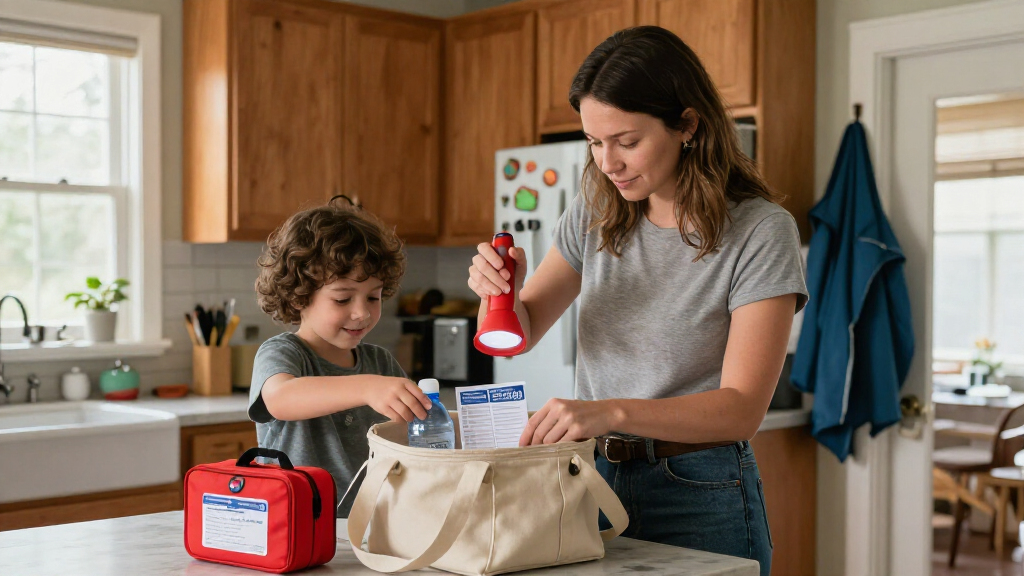

This checklist is for families who want to prepare for emergencies with practical supplies they can organize before they need them. Choose items with your household in mind: who will use them, where they will be stored, and how they fit into your family’s existing plans. Start with your household’s needs and keep instructions easy to find.

Turn the school run and nap time into listening time
- Thousands of audiobooks, podcasts and originals
- Listen on your phone, tablet or Echo — also offline
- Cancel anytime
The checklist is organized by role: first aid, stored water, portable power, communication, water filtration, and emergency food. Each section explains why the category matters, what to check before choosing a product, and who the listed pick may suit. Think of these as separate preparedness jobs; one item does not replace the others.
Use the buying notes to check fit, capacity, compatibility, and ease of use before making a choice. Consider where each item will live and whether the people who may need it can access and operate it. Review the checklist together, then make a simple plan for keeping supplies organized and ready.
Family First Aid Kit
A first aid kit gives your family one place to find supplies when someone needs basic care. The listed pick is the Scherber Fully-Stocked First Responder Bag | EMT/EMS Trauma & Bleeding. Its first responder focus makes it especially important to consider who in your household will use it and whether they are comfortable with the contents. Match the kit to your users, not just the label.
A common buying mistake is choosing a large or specialized kit without checking whether its contents suit your family’s needs or whether anyone knows how to use them. Check the product details for included supplies, organization, and instructions, and compare those with your household’s first aid experience. Consider storage space and whether the bag can be reached quickly. Confirm contents and usability before relying on the kit.
Think about who may carry or access the bag, where it will be kept, and how it fits your family’s preparedness setup. If your household has particular needs, check that the listed contents address them rather than assuming a first responder-style bag covers every situation. Keep it accessible and make sure family members know where it is.
What to look for:
- Check the listed contents against your household’s first aid needs.
- Review organization and access to supplies.
- Consider who can carry and use the bag.
- Check storage dimensions and placement.
- Look for clear instructions and familiar contents.
Scherber Fully-Stocked First Responder Bag | EMT/EMS Trauma & Bleeding Medical K

This comprehensive first responder bag is designed for emergency medical professionals and enthusiasts, containing over 250 supplies including tourniquets, chest seals, bandages, and more. Made from durable, water-resistant polyester with organized compartments, it offers quick access and portability for on-the-go situations.
Pros:
- Includes over 250 essential first aid supplies for emergencies
- Durable and water-resistant construction with organized compartments
- Comfortable, ergonomic shoulder strap and top handle for portability
- Designed for professional EMT/EMS use and training
Cons:
- Large size may be cumbersome for casual use
- Heavy when fully stocked, may be tiring to carry over long distances
Best for: Households seeking a dedicated first responder-style bag.
Not ideal for: Families wanting a compact kit with only familiar basics.
Bottom line: Check the contents and make sure the people who may use this bag can find and handle its supplies.
Emergency Water Storage
Stored water is a core part of household preparedness, and a dedicated tank can give it a defined place in your plan. The listed pick is a 55-Gallon Stackable Emergency Water Storage Tank. Before choosing it, consider how much space your family can devote to water storage and where the tank can be placed. Plan the storage location first so the product fits your home and routine.
One common mistake is focusing on the stated capacity without checking the tank’s dimensions, filled weight, or placement requirements. Confirm those details with the product information and make sure the intended surface and access path work for your setup. The word “stackable” also makes it useful to check the manufacturer’s instructions for stacking and storage. Verify the setup requirements rather than assuming every location is suitable.
Consider how your household will access the stored water and how the tank fits alongside other supplies. Check product guidance on preparation, care, and storage conditions, and decide how you will keep track of those instructions. A tank is only useful if the family can locate and use it as planned. Make access part of the plan, especially if the storage area is separate from daily living space.
What to look for:
- Check the tank’s dimensions and filled weight.
- Confirm placement and surface requirements.
- Review the manufacturer’s stacking instructions.
- Check care and storage guidance.
- Plan how family members will access the tank.
55-Gallon Stackable Emergency Water Storage Tank

This 55-gallon tank is made from rotationally molded polyethylene for long-term potable water storage. Its stackable design saves space, while the 5-inch twist lid and built-in brass spigot make filling, cleaning, and dispensing easier.
Pros:
- Large capacity for emergency water storage
- Stackable design saves floor space
- Includes a twist lid for filling and cleaning
- Built-in brass spigot simplifies dispensing
Cons:
- Large and heavy when filled
- Customer reviews indicate some users may have concerns (4.0/5 rating)
Best for: Families planning a fixed location for stored water.
Not ideal for: Households without room for a large storage tank.
Bottom line: Confirm the tank’s footprint, filled weight, and setup guidance before choosing its storage spot.
Portable Power Station
A portable power station can be part of a family’s plan for keeping selected devices powered during an emergency. The listed pick is the Jackery HomePower 3600 Plus Portable Power Station, 3584Wh, 3600W. Consider which devices your household expects to connect and where the unit will be used. Start with your essential devices so you can check whether the product matches your intended use.
A common mistake is treating capacity and output numbers as a guarantee that every household device will work as expected. Check the product details for supported connections, output limits, charging options, and operating instructions, then compare them with your devices. Think through where the unit will sit and how it will fit into your home or emergency setup. Confirm device compatibility before counting on it.
Consider who will operate the station and whether they can follow the product’s guidance. Check dimensions and handling needs against your storage plan, and keep instructions available to the family. If you intend to use it with particular equipment, confirm that use with the manufacturer’s information rather than making assumptions from the product name alone. Plan the connections in advance and make the setup understandable to the people who may need it.
What to look for:
- Compare supported connections with your devices.
- Check output limits and charging options.
- Review operating and storage guidance.
- Consider placement and handling needs.
- Plan which devices take priority.
Jackery HomePower 3600 Plus Portable Power Station, 3584Wh, 3600W

The Jackery HomePower 3600 Plus is a 3584Wh portable power station with 3600W output, expandable capacity, and support for 120V and 240V operation when units are connected in parallel. It offers AC, solar, gas generator, and hybrid charging, plus a wheeled design with a telescopic handle for easier transport.
Pros:
- High 3584Wh capacity and 3600W output
- Capacity can be expanded for extended backup power
- Supports multiple charging methods, including solar
- Wheels and telescopic handle make it easier to move
Cons:
- 77.2-pound weight may make lifting difficult
- Solar panel is optional
Best for: Households planning backup power for selected devices.
Not ideal for: Families seeking a small, lightweight charging option.
Bottom line: Check device connections and operating limits against the equipment your family plans to use.
Family Emergency Radio
Communication is an important part of coordinating a family plan, particularly when household members may be in different places. The listed pick is the Midland GXT67 PRO 5W GMRS Two-Way Radio, 4-Pack. A four-pack may suit a household planning to distribute radios among several people, but check who needs one and how the family will use them. Plan who carries each radio before selecting a set.
A common buying mistake is assuming radios will work together without checking compatibility, operating instructions, and any requirements that apply to their use. Review the product guidance, included accessories, charging or power method, and controls. Consider whether the intended users can comfortably operate the radios and whether the pack matches your family’s communication plan. Check the details as a group so everyone understands the setup.
Think about where radios will be stored and how family members will keep them ready. Establish a simple plan for who carries a unit, how to contact one another, and where instructions can be found. Do not infer usable range from the product name alone; check the manufacturer’s guidance for your intended setting. Agree on a communication routine before an emergency makes coordination harder.
What to look for:
- Check compatibility and any use requirements.
- Review power or charging method and included accessories.
- Confirm the pack size suits the number of users.
- Consider ease of operation for intended users.
- Read manufacturer guidance for your setting.
Midland GXT67 PRO 5W GMRS Two-Way Radio, 4-Pack

The Midland GXT67 PRO is a rugged, IP67-rated GMRS radio with 99 channels, repeater capability, and NOAA weather alerts for outdoor activities and work. It includes rechargeable batteries and a multi-unit charging dock, supports AA backup batteries, and offers VOX hands-free operation and an SOS siren.
Pros:
- IP67 waterproof and dustproof rating
- Supports repeater networks to extend coverage
- Rechargeable batteries with AA backup option
- Includes NOAA weather alerts, VOX, and SOS siren
Cons:
- FCC license required
- Listed maximum talking range is 2 miles
Best for: Families planning to assign radios to several members.
Not ideal for: Households that do not need multiple two-way radios.
Bottom line: Review compatibility, operating guidance, and who will carry each radio before relying on the set.
Water Filtration System
A water filtration system serves a different role from storing water, so consider how it fits into your household’s overall plan. The listed pick is the Bluevua RO100ROPOT-UV Countertop Reverse Osmosis Water Filter System. Its countertop format makes available counter space and the intended placement key checks. Measure the planned location and review the product’s setup requirements before choosing it.
A common mistake is assuming a filtration system can handle every water source or that its name alone explains what it removes. Check the manufacturer’s information for installation, water-source guidance, filter care, and any stated limitations. Also confirm how the unit is powered or operated and whether its setup suits your kitchen or emergency-use plan. Read the source-water guidance before relying on the system.
Consider who will maintain and operate the unit, where replacement components are handled, and how its instructions will be kept accessible. Check the product details for dimensions and routine care so the system fits the household’s space and habits. A countertop unit may have different practical needs from stored water, so think through its place in your plan. Make maintenance part of ownership and ensure family members know the basic steps.
What to look for:
- Check countertop dimensions and placement needs.
- Review water-source guidance and stated limitations.
- Confirm setup and operating requirements.
- Check filter care and replacement information.
- Consider who will maintain and use the system.
Bluevua RO100ROPOT-UV Countertop Reverse Osmosis Water Filter System

This portable countertop reverse osmosis system uses six filtration stages, including UV treatment and remineralization, to reduce various contaminants and improve water taste. It includes a borosilicate glass carafe, a filter life and water quality display, and requires no plumbing or installation.
Pros:
- Six-stage filtration includes UV treatment and remineralization
- Portable countertop design requires no plumbing or installation
- Glass carafe and filter life monitor are included
- 2:1 pure-to-drain ratio helps conserve water
Cons:
- Requires a corded electrical power source
- Filter replacement is needed, with listed life varying between 12 and 24 months
Best for: Households with counter space and a filtration plan.
Not ideal for: Families seeking a storage-only water solution.
Bottom line: Confirm source-water guidance, setup, and ongoing care before adding this unit to your plan.
Emergency Food Supply
Emergency food supplies help families plan ahead for meals when normal routines are disrupted. The listed pick is the Emergency Zone Family Emergency Survival Kit Backpack. The backpack format makes portability and storage placement useful considerations, while the word “family” is not a substitute for checking what is actually included. Review the contents carefully and compare them with your household’s needs.
A common mistake is assuming a kit will suit every family member without checking its contents, preparation instructions, and any relevant dietary considerations. Review the product details for what is included and how it is prepared or stored. Consider whether the backpack’s size and contents fit the place you intend to keep it, and whether it can be accessed when needed. Check fit for every family member rather than relying on the product title.
Think about who will retrieve the backpack and how it fits alongside your other emergency supplies. Keep the product’s instructions accessible and consider household needs when deciding whether the kit is sufficient for your plan. If family members have specific dietary or preparation requirements, verify those against the listed details. Choose a storage spot everyone can find and review the contents as part of your preparedness routine.
What to look for:
- Check exactly what the backpack includes.
- Review preparation and storage instructions.
- Consider household dietary needs.
- Check pack size and storage placement.
- Plan who can retrieve and carry it.
Emergency Zone Family Emergency Survival Kit Backpack

This family emergency kit packs survival supplies in a discreet, heavy-duty backpack for events such as hurricanes, earthquakes, floods, wildfires, and evacuations. It includes food and water with a five-year shelf life, a 121-piece first aid kit, and an emergency guidebook.
Pros:
- Includes supplies intended for family emergency preparedness
- Food and water have a stated five-year shelf life
- Discreet, heavy-duty backpack design
- Includes a first aid kit and emergency guidebook
Cons:
- The listed backpack and item dimensions differ
- The listed item weight may be unusually low for a fully stocked kit
Best for: Families wanting a backpack-format emergency food kit.
Not ideal for: Households needing a customized food selection.
Bottom line: Verify the kit’s contents and instructions against your family’s needs before relying on it.
Build your checklist in an order that fits your household’s priorities and available storage. Start by identifying essential first aid, water, communication, power, and food needs; then check product fit and instructions before choosing what to add. Let your family’s needs guide the order, and make sure each item has a clear place.
Preparedness works best when everyone knows where supplies are and how to use them. Review the checklist together, keep instructions with the relevant items, and revisit your plan as household needs change. Small, familiar steps add up to a more organized approach to emergencies.