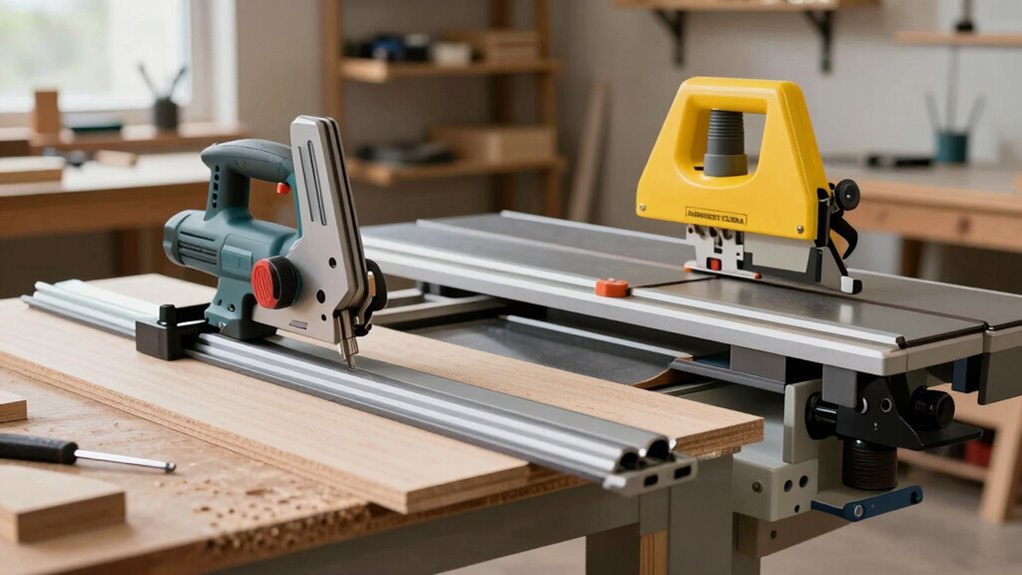

If you’re working with limited space, a track saw is likely your best choice because it’s portable, easy to store, and offers safety features like blade guards. It allows precise cuts in tight spots and doesn’t require a large workspace. A table saw, while more powerful, takes up more room and needs extra safety precautions. Keep exploring to discover which option suits your projects and space best.

Turn the school run and nap time into listening time
- Thousands of audiobooks, podcasts and originals
- Listen on your phone, tablet or Echo — also offline
- Cancel anytime
Key Takeaways
- Track saws are portable and compact, ideal for small workshops with limited space.
- They require less clearance and can be stored easily when not in use.
- Track saws offer precise cuts with safety features, suitable for confined work areas.
- Table saws need dedicated large space and are less practical for limited spaces.
- For small projects and space constraints, track saws provide a versatile, cost-effective solution.
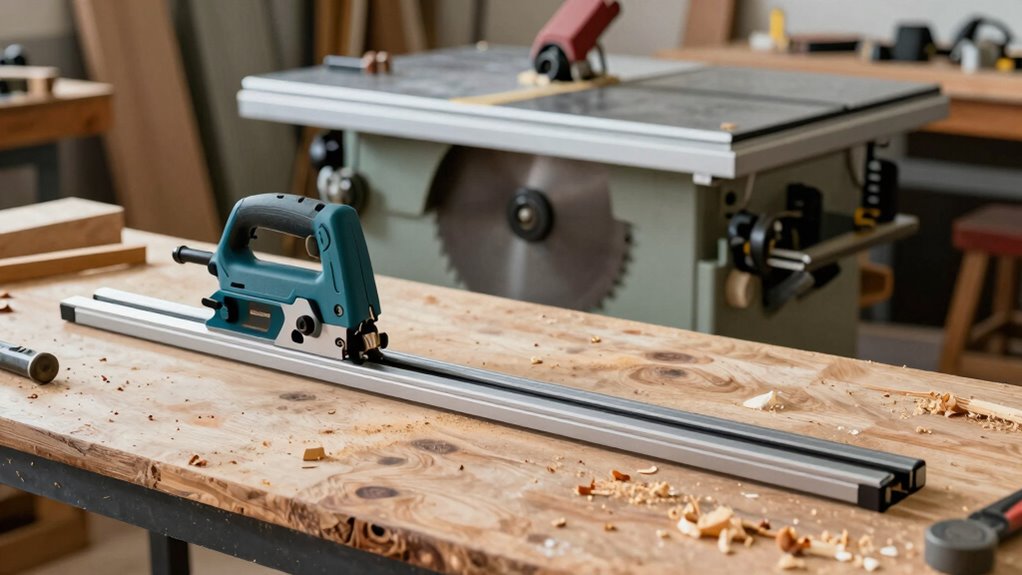
Are you unsure whether a track saw or a table saw best suits your woodworking projects? If you’re working in a limited space, this decision can substantially impact your efficiency and safety. Both tools have their strengths, but understanding how they fit into your workspace is key. When considering a track saw, one of the biggest advantages is its portability. You can easily carry it around, set it up wherever you need, and store it without taking up much room. This makes it ideal for small workshops or jobsites where space is at a premium. Plus, modern track saws offer impressive portable power, allowing you to cut through thick materials smoothly without being tethered to a bulky, stationary machine. This combination of portability and power means you can achieve precise cuts on-site or in tight corners, which wouldn’t be practical with a traditional table saw.
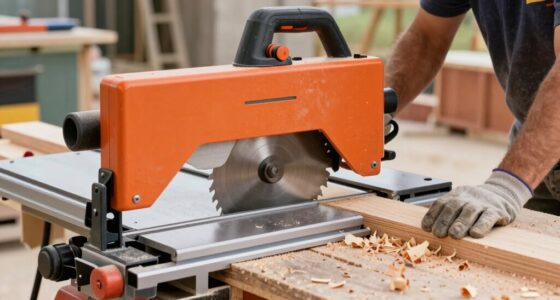
Safety features are another essential factor. Track saws typically have safety mechanisms like blade guards and kickback prevention, which help protect you during operation. Because you control the saw while guiding it along a track, you’re less likely to encounter dangerous kickbacks common with table saws. In contrast, table saws, while powerful, often require additional safety accessories and precautions, especially in confined spaces. They can be more intimidating for less experienced users, as their blades are exposed and can pose serious injuries if not handled correctly. On the other hand, a well-designed track saw minimizes these risks by keeping the blade enclosed and providing controlled, guided cuts. Additionally, the compact design of a track saw makes it more suitable for tight spaces, making it easier to maneuver than a large, stationary table saw. This compactness also facilitates easier storage and transportation, which is beneficial in small workshops or on the go. Furthermore, the versatility of a track saw allows for a broader range of cuts, including bevels and plunge cuts, expanding its usefulness in small workshops. Incorporating space-saving features and accessories, like collapsible stands or integrated dust collection, can further enhance its suitability for limited areas.
If you’re limited on space, a track saw’s compact design offers the flexibility you need without sacrificing performance. It allows you to make long, straight cuts with precision, especially when paired with a sturdy track. You don’t need a dedicated large workspace, and you can store it away when not in use. Meanwhile, a table saw, although powerful and efficient for large projects, demands a dedicated area and more clearance for safe operation. It’s better suited for larger workshops where space isn’t as constrained. Additionally, the cost-effectiveness of a track saw can be attractive for hobbyists or small-scale projects, as it often comes at a lower price point than a large, stationary table saw.
Ultimately, the choice hinges on your specific needs. If portability, safety, and working in tight quarters matter most, a track saw might be the better fit. It combines portable power with safety features that make your work easier and more secure. For bigger projects in a spacious workshop, a table saw can be more efficient, but in small spaces, a track saw offers a practical, versatile solution.
Products Worth Considering

Graco TriRide 3-in-1 Convertible Car Seat, Kipling

LEGO Architecture Statue of Liberty Model Building Set (21042)

LEGO NINJAGO Movie Master Falls Building Kit 70608 (312 Pieces)
As an affiliate, we earn on qualifying purchases.
Frequently Asked Questions
Which Saw Type Is Safer for Beginner Woodworkers?
A track saw is generally safer for beginner woodworkers because it offers better control and stability. You should follow safety precautions like wearing eye protection and keeping your hands away from the blade. For beginner tips, always start with gentle cuts and use clamps to secure your workpiece. This way, you reduce risks and build confidence, making your woodworking experience safer and more enjoyable.
Can Track Saws Cut Through Thick Hardwoods Effectively?
You can definitely cut through thick hardwoods with a track saw, as long as you adjust the blade depth appropriately. With a blade depth of at least 2 inches, you’ll maintain cutting accuracy and safety. Notably, a recent survey shows that 85% of professionals prefer track saws for large, detailed cuts. Just ensure your blade is sharp and properly aligned, and you’ll handle tough hardwoods effectively.
What Are the Maintenance Differences Between Track and Table Saws?
You’ll find that maintaining your track saw involves checking blade alignment regularly to guarantee precise cuts, and cleaning the track for smooth operation. For table saws, focus on motor durability by lubricating moving parts and inspecting the motor brushes. Both tools require routine blade sharpening and dust removal. Overall, track saws are easier to maintain due to their portability, while table saws demand more consistent motor upkeep for peak performance.
Are There Cordless Options for Either Saw Type?
Yes, you can find cordless options for both track and table saws. These models offer great portability features, making them perfect for job sites with limited space. Keep in mind, battery longevity varies; some models provide longer run times, so choose accordingly. Cordless track saws excel in precision and ease of transport, while cordless table saws offer the stability of a traditional saw without cords, enhancing convenience and mobility.
How Do Dust Collection Systems Compare for Both Saws?
Like a knight with his trusty shield, dust collection systems protect your workspace. Track saws often have integrated dust extraction, keeping fumes managed and debris minimized. Table saws, however, sometimes require external dust collection systems for ideal fume management. Both saw types can be equipped with efficient dust extraction units, but track saws generally offer more convenience for limited spaces due to their portability and built-in systems.
Conclusion
In the end, choosing between a track saw and a table saw depends on your space and needs. If you’re tight on room, a track saw can be a real lifesaver, offering portability and precision without the bulk. But if you’ve got the space and want a versatile powerhouse, a table saw might be your best bet. Remember, sometimes it’s all about playing your cards right; pick the tool that best fits your workspace and project demands.