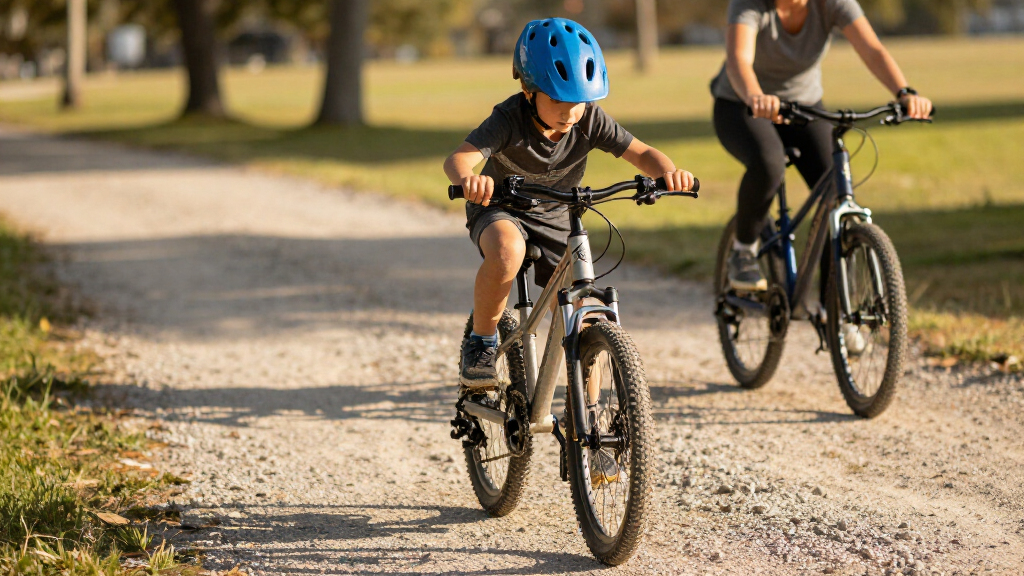
If you’re shopping for the best kids’ bikes with gears, the real decision isn’t whether to get gears — it’s how many, on how heavy a frame, and at what price. My top overall pick is the woom GO 4, because its low weight and intuitive 7-speed twist shifter make gearing something a 6- to 8-year-old actually uses rather than ignores. For bigger kids riding mixed terrain, the woom Explore 5 adds an 8-speed drivetrain and disc brakes, while the WEIZE Kids Mountain Bike stands out as the value play if budget matters most. The main tradeoff in this category: lightweight premium bikes shift crisply and are easy to control, while budget models pack in more gears and features but weigh considerably more. Keep reading for the full breakdown of all nine models.

Turn the school run and nap time into listening time
- Thousands of audiobooks, podcasts and originals
- Listen on your phone, tablet or Echo — also offline
- Cancel anytime
Complete the kit


Key Takeaways
- Weight was the single biggest differentiator: the woom models weigh several pounds less than budget picks like the Glerc and CYBIC, which directly affects whether a child can climb hills and control the bike.
- More gears didn’t mean better biking — 7 well-spaced speeds with a twist shifter proved easier for kids to master than the 21-speed setups on budget mountain bikes, which rely on trigger shifters and front derailleurs kids rarely use correctly.
- The Glerc and WEIZE entries overlap heavily in spec and price; the deciding factors came down to wheel-size range, brake configuration, and included accessories like kickstands.
- Disc brakes appear on both the premium woom Explore 5 and the budget CYBIC, but the quality gap between hydraulic-feel youth discs and cheap mechanical discs showed why price still separates them.
- Hybrid geometry (Retrospec Dart) suits neighborhood and bike-path riders better than mountain-bike styling, making it the pick for families who don’t actually ride trails.
| woom GO 4 Kids Bike, 20 Inch 7-Speed, Ages 6-8 |  | Best Overall for New Gear Riders | Wheel size: 20 inches | Speeds: 7 | Recommended age: 6–8 years | VIEW LATEST PRICE | See Our Full Breakdown |
| WEIZE Kids Mountain Bike, 20/24 Inch Youth Bicycle for Boys and Girls |  | Best for Cushioned Neighborhood and Park Rides | Wheel sizes: 20 or 24 inches | Drivetrain: 6-speed (20-inch) or 18-speed (24-inch) | Recommended rider height: 20-inch: 48–55 inches; 24-inch: 52–66 inches | VIEW LATEST PRICE | See Our Full Breakdown |
| woom Explore 5 Kids Bike, 24-Inch, 8-Speed, Ages 7-11, Disc Brakes |  | Best for Confident Trail Riding | Wheel size: 24 inches | Speeds: 8 | Recommended age: 7–11 years | VIEW LATEST PRICE | See Our Full Breakdown |
| Retrospec Dart 7-Speed Kids Hybrid Bike |  | Best for Adjustable Comfort | Wheel sizes: 20 and 24 inches | Speeds: 7 | Age range: 6–11 years | VIEW LATEST PRICE | See Our Full Breakdown |
| Glerc 20/24 Inch Kids Bike, 7-Speed Children’s Bicycle with Dual Brakes and Kickstand |  | Best Ready-to-Assemble Steel Pick | Wheel sizes: 20 inches; 24-inch option also available | Speeds: 7 | Recommended height: 45–55 inches | VIEW LATEST PRICE | See Our Full Breakdown |
| 20″/24″ Kids Mountain Bike, 7/21-Speed Boys Girls Teenage Bicycle |  | Best for Growing Riders | Sizes: 20-inch, 24-inch | Drivetrain: 7-speed (20″), 21-speed (24″) | Brakes: Front and rear disc brakes | VIEW LATEST PRICE | See Our Full Breakdown |
| CYBIC 20-Inch Kids Mountain Bike, 7-Speed, Disc Brakes, Suspension Fork |  | Best First Geared Bike | Wheel size: 20 inches | Number of speeds: 7 | Brakes: Front and rear cable-actuated disc brakes | VIEW LATEST PRICE | See Our Full Breakdown |
| WEIZE 20- or 24-Inch Mountain Bike for Girls |  | Best Budget Two-Size Option | Wheel sizes: 20 inch and 24 inch | Frame material: High-carbon steel | Brakes: Front and rear caliper brakes | VIEW LATEST PRICE | See Our Full Breakdown |
| Glerc Kids Mountain Bike, 20-Inch |  | Most Gears in a Small Frame | Frame material: High-carbon steel | Wheel size: 20 inches | Drivetrain: 21-speed | VIEW LATEST PRICE | See Our Full Breakdown |
| kids’ bikes with gear | Brakes | Recommended age | Suspension |
|---|---|---|---|
| woom GO 4 Kids Bike | Mini V-brakes | 6–8 years | — |
| WEIZE Kids Mountain Bike | Front and rear V-brakes | — | Front fork and rear shock |
| woom Explore 5 Kids Bike | Hydraulic disc; 160 mm front and 140 mm rear rotors | 7–11 years | — |
| Retrospec Dart 7-Speed Kids Hy | V-brakes with adjustable-reach levers | — | Shock-absorbing |
| Glerc 20/24 Inch Kids Bike | Front and rear V-brakes | — | — |
| 20"/24" Kids Mountain Bike | Front and rear disc brakes | — | Front suspension fork |
| CYBIC 20-Inch Kids Mountain Bi | Front and rear cable-actuated disc brakes | 6–10 years | — |
| WEIZE 20- or 24-Inch Mountain | Front and rear caliper brakes | 20": 6–11 years; 24": 8–14 years | Front suspension fork |
| Glerc Kids Mountain Bike | Disc brakes | 6–12 years | Front suspension fork |
More Details on Our Top Picks
woom GO 4 Kids Bike, 20 Inch 7-Speed, Ages 6-8
The woom GO 4 makes a strong all-around choice for younger riders learning to use gears because its 17.2 lb aluminum frame is easier to manage than the steel WEIZE and Glerc options. Its seven-speed twist shifter includes a turtle-and-rabbit indicator, giving children a simple visual cue as they learn when to shift. Kid-sized mini V-brake levers and an upright position add confidence on neighborhood streets and paved paths. Compared with the more trail-focused woom Explore 5, this 20-inch bike keeps the controls simple and the riding position approachable. The tradeoff is its rigid frame: it lacks the suspension offered by the Retrospec Dart and WEIZE, so rough trails can feel harsher. The listed weight also excludes pedals and a kickstand.
Pros:- Light aluminum frame is easier for young riders to maneuver than the steel WEIZE or Glerc.
- Seven-speed twist shifter has a child-friendly gear indicator.
- Mini V-brakes use levers sized for smaller hands.
- Adjustable saddle supports fit changes as the rider grows.
Cons:- Rigid frame can feel harsh on bumpy trails.
- The stated 17.2 lb weight excludes pedals and kickstand.
Best for: Riders ages 6–8 who want a light, manageable bike for paved paths and occasional easy trails while learning to shift.
Not ideal for: Children who regularly ride rough trails or need suspension to soften bumps; the rigid frame offers no shock absorption.
- Wheel size:20 inches
- Speeds:7
- Recommended age:6–8 years
- Frame:Aluminum
- Weight:17.2 lb, without pedals or kickstand
- Rider height:45–51 inches
- Brakes:Mini V-brakes
- Shifter:Twist grip
Our verdict“Choose the woom GO 4 for a young rider who values easy handling and approachable shifting on mostly smooth routes.”
WEIZE Kids Mountain Bike, 20/24 Inch Youth Bicycle for Boys and Girls
The WEIZE Kids Mountain Bike suits families whose routes include park paths and uneven ground, thanks to its front and rear suspension and wide knobby tires. It comes in two configurations: the 20-inch model has six speeds, while the 24-inch model has 18, so fit and gearing depend on which size a child needs. Compared with the rigid woom GO 4, the WEIZE is better equipped to soften bumps, but its high-carbon steel frame will be heavier to handle. Its twist-grip shifter and V-brakes keep the controls familiar, though the woom GO 4 offers a more specific learning aid with its gear indicator. The listing also notes plastic wheels and required assembly, details worth weighing for frequent or demanding use.
Pros:- Front and rear suspension can soften uneven paths.
- Two wheel sizes offer options for different rider heights.
- Knobby 2.125-inch tires provide grip across varied surfaces.
- Front and rear V-brakes provide braking at both wheels.
Cons:- Steel frame is heavier than the aluminum woom GO 4 and woom Explore 5.
- Plastic wheels may be less durable than sturdier wheel options.
- Assembly is required.
Best for: Families seeking a suspended youth bike for neighborhood rides, park paths, and light trails, with a choice of 20- or 24-inch wheels.
Not ideal for: Smaller or less confident riders who need a lighter bike to lift and maneuver, or families seeking a clearly specified wheel-and-rider fit without checking the size variant.
- Wheel sizes:20 or 24 inches
- Drivetrain:6-speed (20-inch) or 18-speed (24-inch)
- Recommended rider height:20-inch: 48–55 inches; 24-inch: 52–66 inches
- Frame:High-carbon steel
- Suspension:Front fork and rear shock
- Brakes:Front and rear V-brakes
- Tires:2.125-inch knobby
- Shifter:Twist grip
Our verdict“Pick the WEIZE when suspension and tire grip matter more than low weight for park and light-trail riding.”
woom Explore 5 Kids Bike, 24-Inch, 8-Speed, Ages 7-11, Disc Brakes
The woom Explore 5 is aimed at older children ready for longer rides and more varied terrain. Its hydraulic disc brakes and all-terrain tires give it a more trail-oriented setup than the woom GO 4, while the 20.8 lb aluminum frame keeps it lighter than the steel WEIZE. The eight-speed microSHIFT trigger shifter is designed for smaller hands and offers a different control style from the twist shifters on those alternatives. That combination makes this the more capable choice for riders who already handle gears confidently and want disc braking. The tradeoffs are its 24-inch fit, which starts at a listed 49-inch rider height, and a 155 lb rider limit that may shorten its useful span as a child grows.
Pros:- Light aluminum frame weighs 20.8 lb.
- Hydraulic disc brakes provide responsive stopping.
- Eight-speed trigger shifter is designed for smaller hands.
- Kid-focused geometry and adjustable saddle support fit.
Cons:- 24-inch wheels and listed height range make it unsuitable for smaller children.
- The 155 lb rider limit may be reached before a child outgrows the bike.
Best for: Riders about 49–57 inches tall who already have basic shifting skills and want a lightweight 24-inch bike for pavement and trails.
Not ideal for: Younger riders who need a 20-inch bike or a visual aid for learning gears; the GO 4 is more approachable for that stage.
- Wheel size:24 inches
- Speeds:8
- Recommended age:7–11 years
- Recommended height:49–57 inches
- Frame:Aluminum
- Weight:20.8 lb
- Shifter:microSHIFT Acolyte trigger
- Brakes:Hydraulic disc; 160 mm front and 140 mm rear rotors
Our verdict“Choose the woom Explore 5 for a taller, gear-confident child who wants disc brakes and trail-ready equipment in a lightweight bike.”
Retrospec Dart 7-Speed Kids Hybrid Bike
The Retrospec Dart 7-Speed is a flexible hybrid pick for families who want a child to ride a mix of pavement and bumpy paths. Its adjustable seat and handlebar positioning let parents tune the fit at both contact points, while shock-absorbing suspension addresses rougher surfaces than the rigid woom GO 4 can handle. Adjustable-reach V-brake levers also help accommodate smaller hands. Compared with the WEIZE, the Dart has seven speeds across its listed sizes rather than six on the WEIZE’s 20-inch version, though the available details do not specify which wheel size suits which rider. That missing fit guidance makes size selection less straightforward. The listing also gives no frame material or bike weight, so buyers cannot compare carrying effort with the lightweight woom models.
Pros:- Seat and handlebar positioning are adjustable.
- Seven speeds support varied terrain.
- Shock-absorbing suspension helps smooth bumpy paths.
- Adjustable-reach V-brake levers suit different hand sizes.
Cons:- The listing does not map its 20- and 24-inch sizes to rider heights.
- Frame material and bike weight are not specified.
Best for: Families looking for a 7-speed bike with adjustable touchpoints and suspension for a child riding both paved routes and uneven paths.
Not ideal for: Buyers who need clear rider-height guidance or want a published weight and frame material before choosing; the listing omits those details.
- Wheel sizes:20 and 24 inches
- Speeds:7
- Age range:6–11 years
- Brakes:V-brakes with adjustable-reach levers
- Tires:All-terrain tires with deep grooves
- Suspension:Shock-absorbing
- Fit adjustment:Adjustable seat height and handlebar positioning
Our verdict“The Retrospec Dart fits families who value adjustable comfort and suspension, provided they can confirm the right wheel size before buying.”
Glerc 20/24 Inch Kids Bike, 7-Speed Children’s Bicycle with Dual Brakes and Kickstand
The Glerc 7-Speed brings practical setup details to a steel-frame bike: it arrives 85% pre-assembled and includes a kickstand and installation tools. Its seven-speed derailleur and front-and-rear V-brakes give it a conventional geared setup for everyday routes. Compared with the lighter woom GO 4, the 28 lb Glerc will ask more effort from a child when lifting or maneuvering it; the weight may be a greater concern for younger riders. Its internally routed cables are protected from weather, while the Retrospec Dart offers suspension that the Glerc listing does not mention. Fit needs careful checking too: the supplied rider height is 45–55 inches, while the age range spans 6–15 years, a broad estimate that does not replace height and inseam measurements.
Pros:- Seven-speed derailleur supports riding on varied terrain.
- Front and rear V-brakes provide braking at both wheels.
- 85% pre-assembled, with tools included.
- Kickstand is included, and routed cables are protected from weather.
Cons:- At 28 lb, it is substantially heavier than the aluminum woom GO 4.
- Broad age guidance makes height and inseam checks especially important.
- Suspension is not listed for smoothing bumpy trails.
Best for: Families seeking a steel 7-speed bike with included setup tools and kickstand for a rider around 45–55 inches tall.
Not ideal for: Smaller children who may struggle with a 28 lb bike, or riders whose height and inseam fall outside the listed fit guidance.
- Wheel sizes:20 inches; 24-inch option also available
- Speeds:7
- Recommended height:45–55 inches
- Recommended inseam:21–25 inches
- Frame:High-tensile steel
- Weight:28 lb
- Brakes:Front and rear V-brakes
- Assembly:85% pre-assembled; tools and kickstand included
Our verdict“Choose the Glerc for a growing rider who fits its measurements and can manage a heavier steel bike with a convenient included kickstand.”
20″/24″ Kids Mountain Bike, 7/21-Speed Boys Girls Teenage Bicycle
What sets this model apart in the lineup is its two-size, two-drivetrain approach: the 20-inch version runs a simple 7-speed while the 24-inch jumps to a full 21-speed setup, so the bike grows with your child both in size and gearing ambition. Compared with the CYBIC 20-Inch, which is locked to one wheel size and one speed count, this option gives families a clear upgrade path. The magnesium alloy mag wheels keep weight down and never go out of true, though that same design means a cracked wheel can’t be trued or easily swapped like a standard spoked rim. The quick-release seatpost is a nice touch for fast height adjustments between growth spurts. Just keep expectations realistic: the suspension fork is a comfort feature, not a trail-worthy one.
Pros:- Two wheel sizes and speed options create a long upgrade path
- Disc brakes front and rear give consistent stopping control
- Lightweight mag wheels reduce overall bike weight
- Quick-release seat adjusts in seconds without tools
Cons:- Mag wheels limit repair and customization if damaged
- Suspension and gearing are tuned for light trails, not aggressive off-road riding
Best for: Families with a rider between two size brackets who want a bike that lasts through several years of growth
Not ideal for: Kids who ride rough singletrack — the fork and mag wheels are built for pavement and light gravel, not rugged mountain biking
- Sizes:20-inch, 24-inch
- Drivetrain:7-speed (20″), 21-speed (24″)
- Brakes:Front and rear disc brakes
- Suspension:Front suspension fork
- Wheels:Lightweight magnesium alloy mag wheels
- Rider Height (20″):48–62 inches
- Rider Height (24″):4’8″–5’8″
- Assembly:85% pre-assembled, ~20 minutes setup
- Warranty:1-year limited
Our verdict“This pick makes the most sense for a growing rider who needs a bike that stretches across several years and skill levels without buying twice.”
CYBIC 20-Inch Kids Mountain Bike, 7-Speed, Disc Brakes, Suspension Fork
This CYBIC stands out as the most approachable entry point into geared riding in this roundup. A single 7-speed twist shifter is genuinely easier for a six-year-old to master than the 21-speed drivetrain on the Glerc Kids Mountain Bike, where a young rider can get lost in the gear combinations. The twist grip is intuitive — twist to make pedaling easier or harder — and paired with cable-actuated disc brakes, it teaches hand braking with reliable, weather-independent stopping. The tradeoff is weight: the high-carbon steel frame makes it noticeably heavier than the magnesium-wheeled 20-inch option from the earlier pick, which matters when a tired kid asks you to carry the bike home. It’s also capped at 4’9″ of rider height, so taller ten-year-olds will outgrow it fast.
Pros:- Simple 7-speed twist shifter suits first-time geared riders
- Disc brakes front and rear build hand-braking confidence
- CPSC compliant safety standard
- 85% pre-assembled for quick setup
Cons:- Steel frame is heavier than comparable aluminum or alloy builds
- Rider height ceiling of 4’9″ shortens the usable lifespan
Best for: Parents of a 6–8 year old introducing gears for the first time who want simple controls and strong brakes
Not ideal for: Taller or older kids near 4’9″ — they’ll outgrow the 20-inch frame within a season or two
- Wheel size:20 inches
- Number of speeds:7
- Brakes:Front and rear cable-actuated disc brakes
- Shifter type:Twist grip
- Frame material:High-carbon steel
- Recommended age:6–10 years
- Recommended rider height:4’1″–4’9″ (125–145 cm)
- Safety compliance:CPSC compliant
- Warranty:1 year
Our verdict“This model is better suited to a young first-time shifter who needs simplicity over gear range, rather than a rider already chasing hills.”
WEIZE 20- or 24-Inch Mountain Bike for Girls
The WEIZE girls’ model plays a similar two-size game to the 20″/24″ magnesium-alloy bike higher in this roundup, but it cuts costs in the places budget shoppers care about most — and pays for it in the places they’ll notice. The caliper rim brakes are the clearest downgrade: compared with the disc brakes on the CYBIC or the Glerc, they deliver less consistent stopping power in wet conditions, which is a real tradeoff for a bike that’ll see school runs in the rain. What you get in exchange is a wide-adjustability story: the saddle spans 63–84 cm across the two sizes, covering ages 6 through 14, and the adjustable saddle buys serious growing room. The front suspension fork handles neighborhood bumps fine. One gap worth flagging: no published weight limit, so heavier riders are buying on faith.
Pros:- Two wheel sizes cover ages 6–14 in one product line
- Wide saddle height adjustment adds growing room
- Front suspension smooths neighborhood and path riding
- Assembly video included for straightforward setup
Cons:- Caliper rim brakes underperform disc brakes in wet or muddy conditions
- No stated weight limit leaves heavier riders guessing on durability
Best for: Budget-conscious families who want a sizing option that spans multiple kids or several years of growth
Not ideal for: Families in rainy climates or hilly areas — rim calipers don’t match the wet-weather braking of the disc-equipped picks here
- Wheel sizes:20 inch and 24 inch
- Frame material:High-carbon steel
- Brakes:Front and rear caliper brakes
- Suspension:Front suspension fork
- Saddle height:20″: 63–71 cm; 24″: 69–84 cm
- Recommended age:20″: 6–11 years; 24″: 8–14 years
- Recommended rider height:20″: 42–56 inches; 24″: 54–66 inches
- Assembly:85% pre-installed; about 20 minutes
Our verdict“This option stands out for value-minded buyers who prioritize size flexibility and price over premium braking performance.”
Glerc Kids Mountain Bike, 20-Inch
Here’s the outlier of this batch: a 21-speed drivetrain on a 20-inch frame. That’s triple the gear range of the CYBIC and double the range of most 20-inch competitors, including the woom GO 4’s 7-speed setup. For a smaller rider who already lives on hills — or a kid towing siblings up driveway inclines — that range genuinely changes what’s rideable. The disc brakes match the CYBIC’s stopping confidence, and the suspension fork rounds out a spec sheet that reads like an adult bike. The catch is weight: 30 pounds on a 20-inch frame is heavy, roughly the same as many 24-inch bikes, and a struggling six-year-old will feel every pound on a climb or a fall. There’s also a mismatch between the gearing and the age range — most 6-year-olds aren’t ready to manage 21 gears, so this really shines for the 9–12 crowd on the shorter end of the height chart.
Pros:- 21-speed drivetrain is unmatched among 20-inch bikes in this lineup
- Disc brakes deliver responsive, consistent stopping
- Suspension fork dampens vibration on mixed terrain
- Sturdy steel frame handles rough handling
Cons:- 30-pound weight is heavy for a 20-inch bike and hard for small riders to manage
- 21 gears exceed what most 6–8 year olds can operate confidently
Best for: Experienced smaller riders aged roughly 9–12 who ride hilly terrain and know how to work a full gear range
- Frame material:High-carbon steel
- Wheel size:20 inches
- Drivetrain:21-speed
- Brakes:Disc brakes
- Suspension:Front suspension fork
- Recommended age:6–12 years
- Recommended height:45–55 inches
- Recommended inseam:21–25 inches
- Weight:30 lbs
Our verdict“This pick makes the most sense for a skilled, shorter rider who wants adult-level gearing in a kid-sized frame — not for a gear newcomer.”

How We Picked
I evaluated each bike against four criteria that matter most for kids learning to shift: drivetrain usability (shifter type, gear range, and how forgiving the shifting is for small hands), weight relative to wheel size, braking confidence, and overall value including build quality and grow-with-the-child adjustability. Bikes that paired a wide gear range with heavy frames ranked lower, because a 35-pound bike undermines the point of having gears at all. I also weighed how well each model serves its stated age range — a 7-speed twist shifter is well-matched to a 6-year-old, while a 21-speed trigger setup suits a confident 10-year-old rider.
The ranking logic favors bikes that make gears usable over bikes that simply have the most of them. That’s why the woom GO 4 leads the list despite modest specs on paper, and why feature-loaded budget bikes cluster lower: their components work, but they demand more skill and strength from the rider. Within the budget tier, I separated models by wheel-size availability, brake quality, and reports of assembly and durability tradeoffs.
| kids’ bikes with gear | Suspension |
|---|---|
| woom GO 4 Kids Bike | — |
| WEIZE Kids Mountain Bike | Front fork and rear shock |
| woom Explore 5 Kids Bike | — |
| Retrospec Dart 7-Speed Kids Hy | Shock-absorbing |
| Glerc 20/24 Inch Kids Bike | — |
| 20"/24" Kids Mountain Bike | Front suspension fork |
| CYBIC 20-Inch Kids Mountain Bi | — |
| WEIZE 20- or 24-Inch Mountain | Front suspension fork |
| Glerc Kids Mountain Bike | Front suspension fork |
Factors to Consider When Choosing Best Kids’ Bikes With Gears
Before choosing from the nine bikes above, it helps to understand how gearing, weight, and fit interact for young riders. These are the factors I weighed — and the common mistakes that leave parents with a bike their kid refuses to ride.Gear Count: Why Fewer Is Often More
The most common mistake parents make is assuming a 21-speed bike is better than a 7-speed because adults ride more gears. Most kids between 6 and 10 only ever use the rear cassette, and a front derailleur adds weight, complexity, and a second shifter that confuses new riders. A well-spaced 7- or 8-speed rear drivetrain covers virtually every hill a child will encounter. More gears only start paying off for older kids (10+) riding genuine mountain terrain. If your child is just moving up from a single-speed, a simple twist shifter on a 7-speed setup will teach shifting faster than any trigger-shifter triple-chainring bike.
Weight-to-Rider Ratio
A good rule of thumb: a kids’ bike shouldn’t weigh more than about 40% of the child’s body weight. Premium brands hit this easily; many budget 20-inch mountain bikes with steel frames and suspension forks blow past it. A heavy bike with gears is the worst combination — the child lacks the leg strength to push extra weight uphill even in the lowest gear, and the gearing becomes decoration. Suspension forks are a major culprit, adding 3-5 pounds of bounce without meaningful damping on cheap models. If your priority is hills and trails, spend your budget on a lighter aluminum frame before spending it on suspension.
Brakes: Discs vs. Rim for Small Hands
Gears let kids ride faster, which makes braking performance a safety issue, not a spec-sheet line item. Mechanical disc brakes offer better wet-weather stopping and don’t wear out rims, but budget versions can feel stiff for small hands. Quality V-brakes on a lighter bike often outperform cheap discs on a heavy one. Check that levers are short-reach and adjustable — a child who can’t fully squeeze the lever will drag the brake or avoid it entirely. Discs make the most sense for kids riding trails or in wet climates; rim brakes are fine for neighborhood riding on lighter bikes.
Wheel Size and Fit Over Features
Choosing by age range printed on the box is unreliable — kids vary widely in height and inseam. Instead, your child should be able to stand over the top tube with both feet flat and roughly an inch of clearance. A 20-inch bike typically fits inseams of 20-24 inches; 24-inch bikes fit roughly 24-28 inches. Don’t buy up a size to ‘grow into it’ — an oversized bike with gears is harder to control precisely when the child needs the control most. Some models in this lineup come in both 20- and 24-inch versions, which helps if you’re matching siblings or want a known frame your child already fits.
Assembly and Long-Term Maintenance
Nearly every bike in this price range arrives partially assembled, and derailleur setup is the one step most often botched at home. Poorly indexed gears skip and grind, which teaches kids that shifting is frustrating. Budget an hour of careful setup, or a shop tune-up, for any geared kids’ bike — it’s the difference between a bike that shifts crisply and one that gets abandoned. Also factor maintenance: twist shifters are nearly maintenance-free for kids, while trigger shifters and front derailleurs need periodic cable adjustment. Steel frames rust if stored outside; aluminum doesn’t, but costs more.
Riding Style: Hybrid vs. Mountain Geometry
Mountain-bike styling dominates kids’ geared bikes, but most families ride pavement and gravel paths, not singletrack. If that’s you, a hybrid geometry with a more upright posture and smoother tires — like the Retrospec Dart — is genuinely more comfortable and faster on pavement. Mountain geometry with knobby tires suits kids who ride dirt, grass, and loose gravel regularly, where the aggressive tires and lower gearing earn their keep. Matching the bike to actual riding, not to how cool it looks, is the cheapest way to get the buying decision right the first time.
Frequently Asked Questions
What age should a kid start riding a bike with gears?
Most kids are ready for gears between ages 6 and 8, once they’ve mastered balancing, braking, and riding with one hand briefly. The signal isn’t age so much as riding variety — if your child is pedaling up hills, slowing to walking pace on climbs, or complaining their single-speed is ‘too hard,’ gearing will genuinely help. Start with a simple 7-speed twist shifter, which most kids understand in a single ride because you twist it like a throttle. Trigger shifters and multiple chainrings are better introduced around age 9 or 10, when hand strength and coordination catch up. Introducing gears too early usually results in a shifter that gets ignored or fiddled with constantly, so judge readiness by riding skill rather than the age printed on the box.
Is it worth paying more for a woom instead of a budget geared bike?
The premium price buys weight, and weight is the spec that most changes how a kid rides. A woom in the 20-inch class can weigh several pounds less than a comparably equipped budget bike, and for a 50-pound child that difference is like an adult riding a bike 15 pounds heavier. Lighter bikes climb better, handle more predictably, and are easier for a tired kid to pedal home — which means more riding happens. Budget bikes compensate with more gears, disc brakes, and included accessories, and for families on tight budgets or occasional riders, those features may matter more. But if your child rides several times a week or faces real hills, the lighter bike is worth the extra cost, and premium bikes also hold resale value surprisingly well.
Do cheap suspension forks on kids’ mountain bikes actually help?
Almost never at the budget level. The suspension forks on entry-level kids’ bikes typically add 3-5 pounds and deliver springy bounce without real damping, which wastes pedaling energy and can make the front end feel vague. For a child riding smooth trails, gravel, or pavement, a rigid fork is lighter, cheaper, and more efficient. Genuine kid-sized air-sprung suspension exists, but it costs more than entire bikes in this roundup. The CYBIC in this lineup includes a suspension fork and disc brakes at a budget price, which looks great on a listing but means the money went to visible features rather than frame quality. Skip suspension unless your child is riding rough, rocky trails regularly — and if they are, that’s a conversation about a dedicated youth mountain bike brand instead.
Should I choose rim brakes or disc brakes for my child?
Disc brakes matter when your child rides fast, rides wet conditions, or rides trails — they stop more consistently and don’t lose grip in rain the way rim brakes can. But brake type matters less than lever reach and cable quality: a well-adjusted V-brake on a light bike stops better than a poorly set up mechanical disc on a heavy one. Check that the levers adjust short enough for small hands, because a child who can’t fully squeeze the lever will hesitate to brake at all. If comparing two similarly priced bikes, discs are a reasonable tiebreaker, but don’t pick a significantly heavier bike just because it says ‘disc brakes’ on the listing. For pure neighborhood riding in dry climates, quality rim brakes are completely adequate and cheaper to maintain.
Can I size up to a 24-inch bike so my child grows into it?
It’s tempting, but it usually backfires with geared bikes specifically. An oversized frame forces your child onto tip-toes at stops, which erodes confidence exactly when they’re also learning to shift. Gears demand more bike control than single-speeds, because reaching for a shifter takes a hand off steady handlebar grip and climbing in the wrong gear causes wobbles. The safer move is buying the correct size now, riding it a season or two, then selling it — kids’ bikes in good condition resell quickly, which offsets the ‘wasted’ growth. If your child is right between a 20- and 24-inch bike, choose based on standover height and inseam rather than the age label, and lean toward the smaller size if they’re new to gears.
Conclusion
The right pick here depends less on specs and more on your rider. For the best overall balance of usability, weight, and gearing, the woom GO 4 is the standout — it makes gears something a young rider actually learns and enjoys. Families wanting the best premium option for older, more adventurous kids should look at the woom Explore 5, whose 8-speed drivetrain and disc brakes justify the price for trail and hill riding. For best value, the WEIZE Kids Mountain Bike delivers functional gearing and both wheel sizes at a budget-friendly price point, with the Glerc 20/24 as a close alternative if its configuration fits your child better.
For beginners just moving off single-speeds, the woom GO 4’s twist shifter is again the easiest entry point, though the Retrospec Dart’s 7-speed hybrid design suits cautious neighborhood riders who will never see a trail. For specific needs: the CYBIC covers families who want disc-brake styling on a tight budget (accepting the weight penalty), the 7/21-speed mountain bike suits confident older riders who genuinely ride varied terrain, and the WEIZE girls’ model rounds things out for a lighter-duty budget build. Whatever you pick, budget for a proper gear-indexing setup at delivery — it’s the cheapest upgrade to how any of these bikes ride.
Fall Picks
fall essentials
As an affiliate, we earn on qualifying purchases.