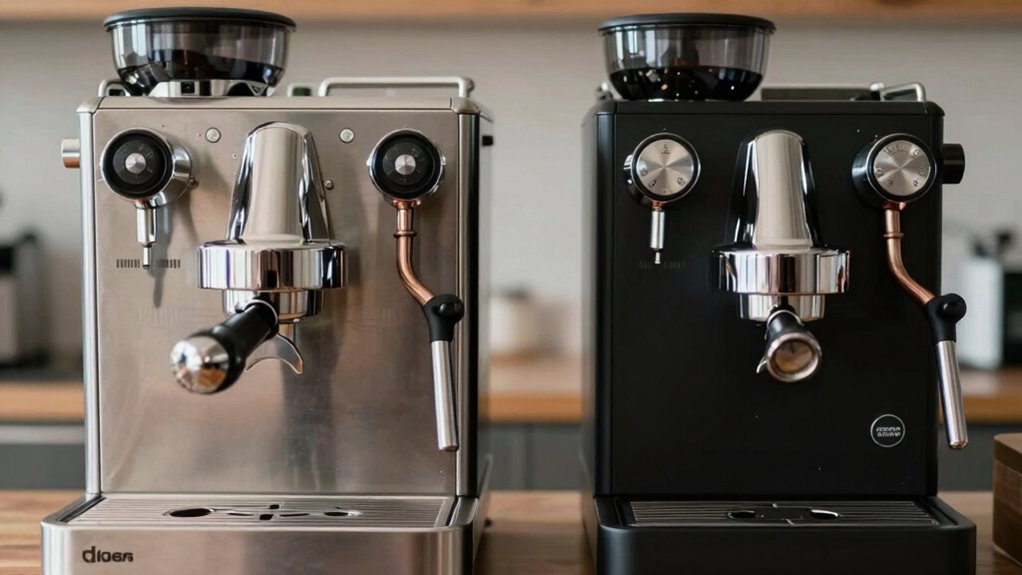
If you want precise temperature control and consistent results, a dual boiler is your best bet, ideal for brewing multiple drinks or milk-based beverages. On the other hand, if space-saving design and affordability matter more, a heat exchanger can work well, but it requires more attention to temperature adjustments. Your choice depends on how much control you need and how often you want to switch between brewing and steaming. Keep going to discover more about which option suits your brewing style.

Turn the school run and nap time into listening time
- Thousands of audiobooks, podcasts and originals
- Listen on your phone, tablet or Echo — also offline
- Cancel anytime
Key Takeaways
- Dual boilers provide separate, stable temperatures for brewing and steaming, ideal for consistency and milk-based drinks.
- Heat exchanger machines are more compact and cost-effective but require more skill to maintain optimal brewing temperatures.
- Dual boilers excel for users who prioritize temperature stability and fine-tuning for different coffee beans.
- Heat exchangers are suitable for space-conscious users willing to monitor and adjust settings during operation.
- Proper grinder calibration and fresh beans are essential for both machine types to achieve high-quality espresso.
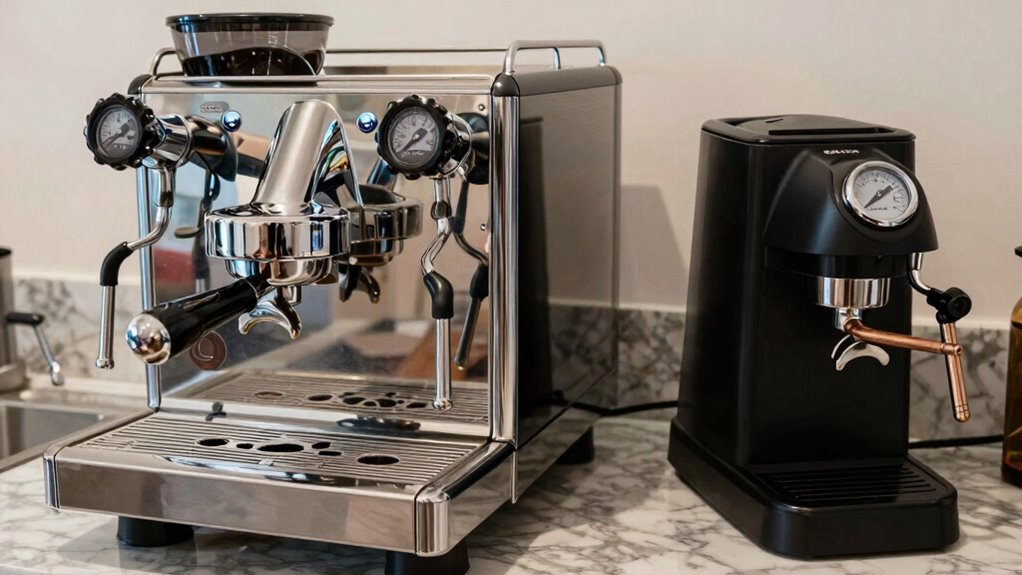
Choosing the right espresso machine can greatly impact your brewing experience, especially when deciding between a dual boiler and a heat exchanger model. Both styles have their strengths, but understanding how they operate helps you make an informed choice. With a dual boiler, you get separate chambers for brewing and steaming, allowing you to heat water to precise temperatures independently. This setup offers consistent results, especially if you like to brew multiple drinks in a row or prefer milk-based beverages. On the other hand, a heat exchanger machine heats water in a single boiler but uses a copper or stainless-steel tube to extract hot water for brewing while simultaneously steaming milk. This design is more compact and often more affordable, making it an appealing option for home baristas.
Your choice between the two depends on your brewing habits and preferences. If you’re serious about temperature stability and want to fine-tune your espresso shot, a dual boiler gives you the advantage of consistent brewing temperatures, which can be crucial when working with different coffee bean varieties. Different beans may require slight adjustments in temperature to bring out their best flavors, and a dual boiler allows you to do that without sacrificing steam power or risking temperature fluctuations. Additionally, grinder calibration plays a vital role regardless of your machine choice. Properly calibrated grind size ensures optimal extraction, unlocking the full potential of your coffee beans. Whether you use a dual boiler or a heat exchanger, starting with fresh, high-quality beans and maintaining your grinder’s accuracy makes a significant difference in your espresso quality.
While both machines can produce excellent espresso, the dual boiler’s ability to maintain stable temperatures makes it more forgiving, especially when experimenting with different bean varieties. You can dial in your shot more precisely, which is essential if you enjoy exploring various roasts and origins. The heat exchanger, however, can be very efficient once you’re familiar with its quirks, but it may require more attention to temperature adjustments and timing. Understanding machine operation and how it affects your shot consistency can help you choose the right model for your skill level and preferences. Moreover, a thorough understanding of temperature control can significantly enhance your brewing results and help you decide which machine best suits your needs. In addition, maintaining consistent brewing conditions can also extend the lifespan of your equipment and improve overall coffee quality. Ultimately, your decision should consider how much control you want over your brewing process and how often you’ll need to switch between brewing and steaming.
As an affiliate, we earn on qualifying purchases.
Frequently Asked Questions
Which Machine Is Easier for Beginners to Operate?
You’ll find a heat exchanger espresso machine easier for beginners because it offers more straightforward operation. It maintains good temperature stability for milk frothing, making it simpler to get consistent espresso shots. Dual boilers require more experience to manage both boilers simultaneously, which can be tricky for newbies. With a heat exchanger, you can focus on perfecting your milk frothing and brewing, making the learning curve smoother and more enjoyable.
How Does Maintenance Differ Between Dual Boiler and Heat Exchanger Machines?
You’ll find that maintenance differs mainly in calibration procedures and descaling frequency. Dual boiler machines often require more frequent descaling due to their complex heating systems, and calibration procedures can be more involved to guarantee temperature stability. Heat exchanger machines usually need less frequent descaling and simpler calibration. Regularly following these maintenance routines keeps your machine running smoothly and extends its lifespan, regardless of the type you choose.
Can a Heat Exchanger Machine Produce the Same Quality Espresso as a Dual Boiler?
A heat exchanger machine can produce remarkably close espresso quality, especially with precise control of brew temperature, ensuring your shots are consistently rich. While it might not match the dual boiler’s steam capacity for simultaneous steaming and brewing, it’s still capable of delivering excellent espresso. You’ll enjoy flavorful shots and efficient operation, making it a versatile choice for home or small café use, without sacrificing much in quality.
What Are the Typical Energy Consumption Differences?
Heat exchanger machines generally consume less power than dual boiler models, making them more energy-efficient. They use a single boiler with a heat exchange system, which reduces overall power consumption. Dual boilers, meanwhile, have separate heating elements for brewing and steaming, leading to higher energy use. If energy efficiency is your priority, a heat exchanger machine typically offers lower power consumption, saving you energy and potentially reducing electricity costs.
Are There Significant Size Differences Impacting Kitchen Space?
Yes, size differences can impact your kitchen space. Dual boiler machines tend to be larger due to their separate boilers, requiring more counter space and potentially affecting your kitchen layout. Heat exchanger machines are generally more compact, fitting better on limited countertops. If you have a small kitchen, a heat exchanger might be more practical, but if space isn’t an issue, a dual boiler offers advanced features and efficiency.
As an affiliate, we earn on qualifying purchases.
Conclusion
Ultimately, choosing between a dual boiler and a heat exchanger espresso machine depends on your brewing style and priorities. While a dual boiler offers more finesse and control, a heat exchanger can deliver impressive results with a bit of practice. Think of it as finding the right rhythm—sometimes, the simpler path leads to the most satisfying brew. Whichever you opt for, your passion for great coffee will ensure every cup brings you closer to perfection.
professional espresso machine for home use
As an affiliate, we earn on qualifying purchases.
As an affiliate, we earn on qualifying purchases.
automatic milk frother for espresso
As an affiliate, we earn on qualifying purchases.
As an affiliate, we earn on qualifying purchases.
Fall Picks
fall essentials
As an affiliate, we earn on qualifying purchases.