TL;DR

Turn the school run and nap time into listening time
- Thousands of audiobooks, podcasts and originals
- Listen on your phone, tablet or Echo — also offline
- Cancel anytime
Pennsylvania educator Lori McGarry describes how first- and second-graders worked through a dispute over a classroom guinea pig and settled on occasional visits plus a class fish. The opinion article argues that deliberation over shared, age-appropriate problems can give students practice in civic participation, while noting that its pilot research is not long-term causal evidence.
An opinion article published by The 74 describes how Pennsylvania educator Lori McGarry guided first- and second-graders through a disagreement about a classroom guinea pig, reaching a compromise that allowed occasional visits and added a class fish. The piece argues that working through shared decisions can help young students practice listening, weighing trade-offs and considering who is affected—skills the authors say are often less emphasized than learning about democratic institutions.
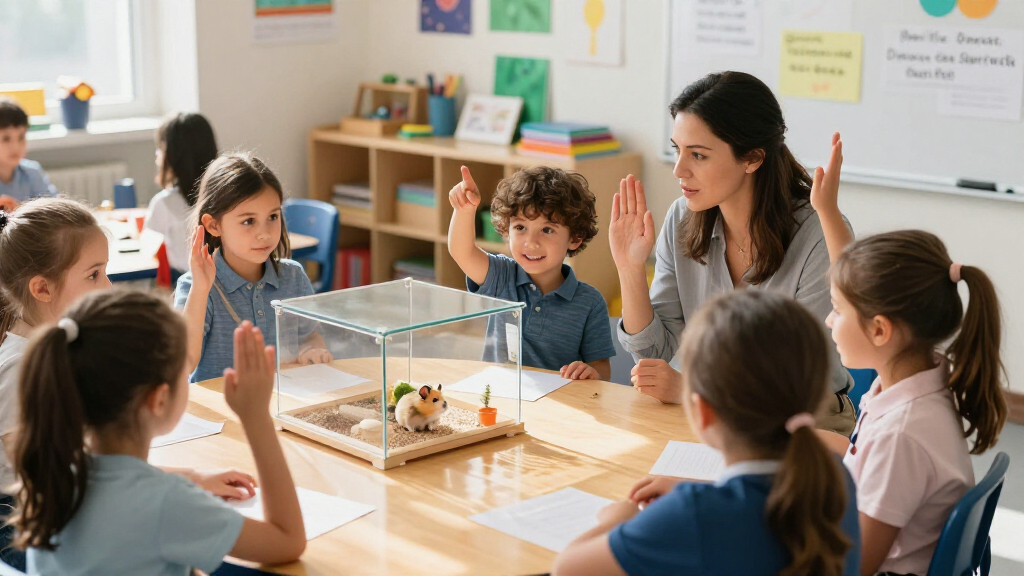
A family offered to lend McGarry’s class a guinea pig for the school year. The proposal prompted questions about fairness, classmates with allergies and how much attention the animal was drawing during recess, lunch and math. Rather than ask students to vote immediately, McGarry gave them construction paper, drawings, pluses and minuses, and a talking stick to discuss four possible approaches.
The children identified advantages and drawbacks and listened to one another. One student reconsidered a preferred option after thinking about the possibility that a classmate could become sick. The class’s eventual compromise was to let the guinea pig visit sometimes and get a fish. According to the article, students later applied similar questions to other classroom problems, including who should be heard and what the class still needed to understand.
The authors also describe a mixed-methods pilot of classroom deliberation resources developed with the USC Democracy Project. In a pilot involving 23 educators, 95% of participating teachers rated the curriculum highly relevant. Teachers reported authentic student engagement and connections between public issues and students’ lives. The article says students discussed topics including gun violence, human rights, policing and safety, and local water pollution.
Classroom Decisions Build Civic Practice
The article’s central argument is that civics learning can include practice, not only instruction about government and democratic institutions. Deliberation, as the authors describe it, asks students to examine a shared problem, consider evidence and trade-offs, hear differing views and work toward a decision or next step.
That approach may matter to educators looking for ways to make civic learning relevant without starting with a highly divisive issue. The authors suggest beginning with matters students encounter directly, such as recess, classroom cleanliness or a pet. In their account, the guinea pig discussion gave children a concrete way to recognize that a decision can affect classmates differently—and that a majority preference is not the only consideration.
The reported pilot offers an early indication of teacher interest and classroom engagement, not proof that deliberation causes lasting changes in students’ civic knowledge or behavior. Still, the article presents the classroom example and teacher reports as reasons to give students structured opportunities to make decisions together.
As an affiliate, we earn on qualifying purchases.
From Pet Dispute to Civics Lesson
The article frames its argument against the backdrop of the United States approaching the 250th anniversary of the Declaration of Independence and preparing for another general election. The authors say students may hear about democracy during these milestones but do not necessarily get regular chances to take part in shared decision-making.
They distinguish deliberation from an unstructured discussion or a contest to defeat an opponent. Their proposed format includes a real problem, more than two reasonable options, visible trade-offs, and norms that support evidence and listening. The teacher should not prescribe the conclusion, they write; students should help identify a next step, act and reflect.
The class pet story is offered as a starting point, not as evidence that one classroom activity can resolve broader civic challenges. The article moves from that small decision to examples of students examining public issues, including researching local water pollution and presenting arguments to peers or local officials.
“The class eventually found a compromise. The guinea pig could visit sometimes, and the class would get a fish.”
— Lori McGarry, Pennsylvania educator, as described in The 74 article
As an affiliate, we earn on qualifying purchases.
Pilot Findings Have Limits
The article says the pilot findings draw on teacher reports and classroom artifacts, rather than long-term causal evidence. It does not establish whether deliberation lessons lead to lasting changes in students’ civic participation, knowledge or attitudes, or how those outcomes compare with other teaching approaches.
The source also does not provide further detail here about the pilot’s duration, the educators’ locations, or how the participating teachers were recruited. The 95% figure refers specifically to participating teachers who rated the curriculum highly relevant; it should not be read as a measure of student outcomes or a result representative of all schools.
McGarry’s classroom account is presented as an example in an opinion article. The source does not independently evaluate the classroom episode or report how the class’s approach developed after the described decisions.
deliberation discussion cards for kids
As an affiliate, we earn on qualifying purchases.
As an affiliate, we earn on qualifying purchases.
Teachers Asked to Schedule Deliberation
The authors urge teachers and school leaders to put at least one genuine deliberation on the school-year calendar. They propose asking students what is happening, who is affected, which values or costs are in tension, what remains unknown and what action the group could take together.
They recommend starting with a shared, manageable concern and offering several reasonable approaches, while setting expectations for evidence and listening. The article does not announce a new program or a formal deadline. Its proposed next step is for schools to create opportunities for students to discuss, decide, act and reflect.
children's voting and decision-making kit
As an affiliate, we earn on qualifying purchases.
As an affiliate, we earn on qualifying purchases.
Key Questions
What happened in Lori McGarry’s classroom?
A family offered to lend the class a guinea pig, prompting concerns about fairness, allergies and disruption. The students discussed four approaches and agreed that the guinea pig could visit sometimes while the class also got a fish.
Why does the article connect a class pet to democracy?
The authors argue that students can practice civic skills by discussing shared problems, listening to different perspectives, considering trade-offs and choosing a next step together. They present the pet decision as a small example, not a substitute for broader civics education.
What did the classroom deliberation pilot find?
In a mixed-methods pilot with 23 educators, 95% of participating teachers rated the curriculum highly relevant. Teachers also reported student engagement. The article says the findings are based on teacher reports and classroom artifacts, not long-term causal evidence.
Does the article show that deliberation improves civic outcomes?
No. The authors describe promising early observations, but the source does not provide long-term causal evidence showing that classroom deliberation changes students’ civic knowledge or behavior over time.
Source: rss
Fall Picks
fall essentials
As an affiliate, we earn on qualifying purchases.